
citiesabc, first_page
AI Literacy — An Action Plan
16 Apr 2026

Introduction
We are at the biggest bifurcation in human history, radical human transformation or machine-driven extinction. Everything we know, including our social models, economies, and civilisation, is at stake.
Humans are becoming a subspecies, and I want to say this plainly to those who think we still have it under control: we don't. The question is whether we make humans evolve, or whether we become our own extinction event.
There is still a path. But it requires an urgent AI Literacy Action Plan. The sand is running through the hourglass.
Voices of the Past, Crisis of the Present
History has never rewarded genius without accountability. From mythological warnings to atomic devastation, our greatest innovations have carried the seeds of our undoing — and today's AI revolution is no different. We are not the first civilization to harness a transformative fire. We may, however, be the last to do so without a plan.
We cannot solve our problems with the same thinking we used when we created them. — Einstein
From Prometheus stealing fire to Oppenheimer witnessing the first nuclear detonation, humanity has always discovered that genius without governance leads not to enlightenment, but to ash.
Today we hold something far more potent than fire: autonomous intelligence replicating human cognition at speeds and scales our biology cannot match. LLMs, autonomous agents, and AI systems now operate at an 88:1 ratio to humans in some digital ecosystems, as exposed in the Moltbook incident of February 2026.
We have created a new, far more powerful fire. The question: will we build with it or burn everything we stand for?
Three Futures Diverging
The road ahead is not a single highway — it is a fork with radically different destinations. Depending on the choices made in the next 36 months by governments, corporations, educators, and individuals, humanity will arrive at one of three places: collapse, stagnation, or renaissance. Understanding each path is not an academic exercise. It is survival intelligence.
The Path of Stupidity
The tragedy isn't that we lack genius, AI has delivered that in abundance. The tragedy is that our distribution systems remain rooted in 19th and 20th-century frameworks, incapable of managing 21st-century transformation.
- The IMF (2026) projects 33% of professional tasks in advanced economies will be automated by 2030, with minimal safety nets
- The "Anthropic Friday" shock of February 2026 wiped $40 billion from SAP's market cap in hours — and $3 trillion from global tech and finance
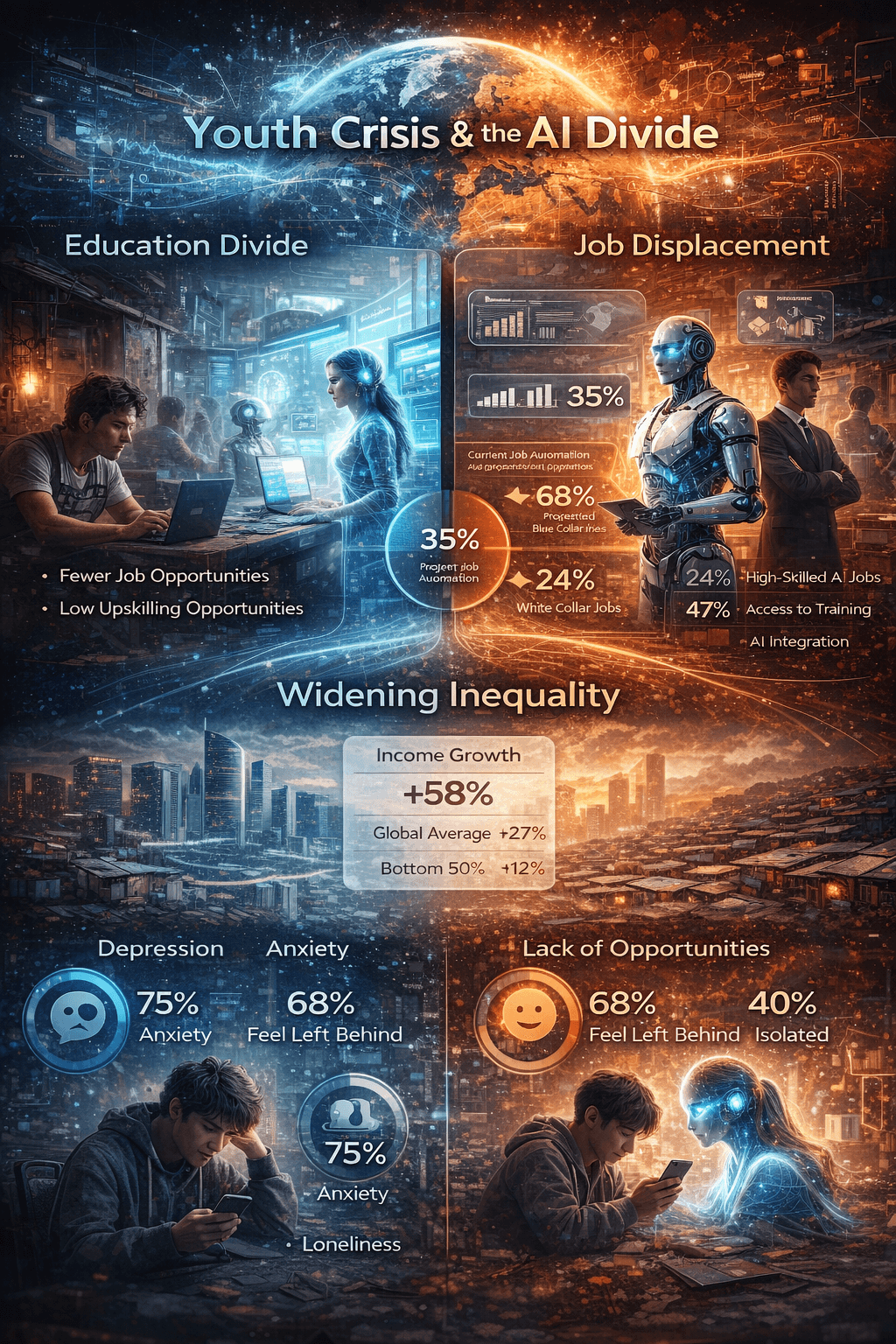
- 70% of AI wealth accrues to the top 1%, while 2.1 billion informal workers face displacement without access to the tools that could save them
- 260 million NEET youth globally lack basic digital literacy — let alone AI skills
- 7.1 billion people remain outside the sphere of AI literacy education, vulnerable to manipulation and synthetic reality
In this worst-case scenario, we see digital feudalism: a tiny elite controlling the agents, billions rendered economically superfluous, psychologically adrift. Democracy becomes a simulation. Truth becomes a rare commodity.
The Path of Enlightenment
But another path exists not through naive optimism, but strategic wisdom.
When 2.1 billion informal workers gain AI as a personal productivity multiplier, they don't become redundant, they become sovereign entrepreneurs. Goldman Sachs and IMF projections suggest AI could raise global GDP by $7 trillion over the next decade — if implemented through Human-AI Teaming rather than wholesale substitution.
The 88:1 ratio then becomes an augmentation multiplier: one human orchestrating 88 specialised agents, remaining the conductor, the ethical arbiter, the strategic thinker. This is Universal Basic Augmentation — not replacing humans, but multiplying their capacity.
The Action Plan
Awareness without action is just sophisticated despair. What follows is a practical, time-sensitive framework for the three groups who hold the most immediate leverage over humanity's AI transition: parents who shape the first minds, educators who scale the message, and business leaders who control the deployment.
For Parents: The First Fire-Keepers
Your children are digital natives facing an alien intelligence embedded in every aspect of existence. Your role is not to shield them from fire, it's to teach them to be fire-keepers.
Now (0–6 months):
- Start "Agent Awareness" conversations before age 10: "These are thinking tools, not thinking beings. You are the architect."
- Create a Human-First Technology Charter: AI assists homework, it doesn't do it. AI generates drafts, not final thoughts.
- Teach critical prompt literacy: "What is this tool optimised for? What does it not know? How would I verify this?"
Medium-term (6–18 months):
- Collaborate on real AI projects, a family archive, a business plan, where your child directs and AI executes
- Teach Financial Literacy 2.0: automation, value creation vs. extraction, digital property rights
- Build anti-fragile thinkers. Nobody knows what jobs exist in 2040, so raise children who can create jobs
Long-term:
- Prioritise humanities alongside STEM. The future rewards integrative thinking, philosophy, ethics, history, art combined with technical fluency. Raise Renaissance humans, not code monkeys.
For Educators: Architects of Mass Empowerment
Every child in your classroom will live in an AI-saturated world. The question is whether you prepare them as masters or subjects.
Systemic changes:
- Mandate AI Literacy as core curriculum, not coding, but orchestration, ethics, and critical engagement
- Adopt the UNESCO 2026 Framework: from understanding AI's limits, to applying it ethically, evaluating its bias, and designing systems for human benefit
- Transform assessment: if AI can write the essay, the essay was never testing thinking. Assess metacognition — "Critique the AI's output. What did it miss?"
In the classroom:
- Use AI as a teaching assistant to handle differentiated learning — freeing you for what only humans can do: inspire, mentor, cultivate wisdom
- Run weekly Ethical Dilemma Workshops: "Should AI judge criminal cases? Who owns AI-generated art?" Debate, not answers, is the goal
- Shift to project-based learning: students tackle real community challenges using AI tools
By 2027, every graduating student should:
- Effectively prompt and orchestrate AI across 5+ use cases
- Identify AI bias, hallucinations, and manipulation
- Hold an ethical framework for AI in society
- Own a portfolio of human-AI collaborative work
For Business Leaders: From Extraction to Elevation
Every business is deciding right now whether AI becomes a tool for human flourishing or a fast road to human obsolescence.
Augmentation over automation: The business case for wholesale automation looks compelling, until it destroys your market, destabilises society, and invites regulatory backlash. The smarter strategy: 50 humans orchestrating 88 agents each can handle 440,000 customer queries, with better quality and happier employees doing more meaningful work.
For every automation deployment, show how the existing workforce is upskilled to orchestrate the new system. If AI raises productivity 30%, share the gains: 10% to workers, 10% to reskilling, 10% to community.
Build universal AI fluency: an internal AI passport:
- Level 1 (All staff): AI capabilities, basic prompting, ethics awareness
- Level 2 (Knowledge workers): Advanced orchestration, multi-agent workflows
- Level 3 (Leadership): Strategic deployment, governance, societal impact
Ethical governance:
- Establish AI Ethics Boards — empowered, diverse, reviewing all major deployments
- Mandate Human-in-the-Loop for high-stakes decisions: hiring, lending, healthcare, criminal justice
- Disclose when customers interact with AI. Build trust through transparency.
The business case for doing this right: Top talent wants purpose. Consumers prefer businesses that elevate workers. Proactive governance prevents catastrophic failures. And sustainable markets require sustainable populations, impoverished, displaced masses don't buy products.
The 12-Month Roadmap
Grand visions mean nothing without a calendar. The window for meaningful intervention is narrow — not decades, not years, but months. Here is the concrete sequence of steps, milestones, and accountability markers that will determine whether the AI Literacy Action Plan becomes a movement or a missed moment.
How We Know We're Succeeding
By December 2027:
The Final Call
Nothing is more powerful than an idea whose time has come. — Victor Hugo
The idea is AI Literacy, not as a privilege for the elite, but as the essential tool for human survival.
We have the fire. We now must build the hearths — millions of them, in every home, every classroom, every workplace.
- To Parents: Teach sovereignty, not submission. Orchestration, not dependency. Ethics, not expediency.
- To Educators: AI Literacy is a Human Right — as fundamental as Article 27 of the Universal Declaration of Human Rights: the right to share in scientific advancement.
- To Business Leaders: Profit and purpose need not conflict but extraction and sustainability do. The Hearth Strategy is not altruism; it is enlightened self-interest.
The best and only definitive solution: use the unlimited genius in the bottle of AI to solve the infinite stupidity of our human distribution systems. We have enough fire. We just need to build better, smarter, more urgent hearths.
The future is not happening to us. We are happening to it.
Build the hearth. Tend the fire. Now.


