
citiesabc
AI Usage Primarily for Human Needs Before Going Corporate
14 Jan 2026

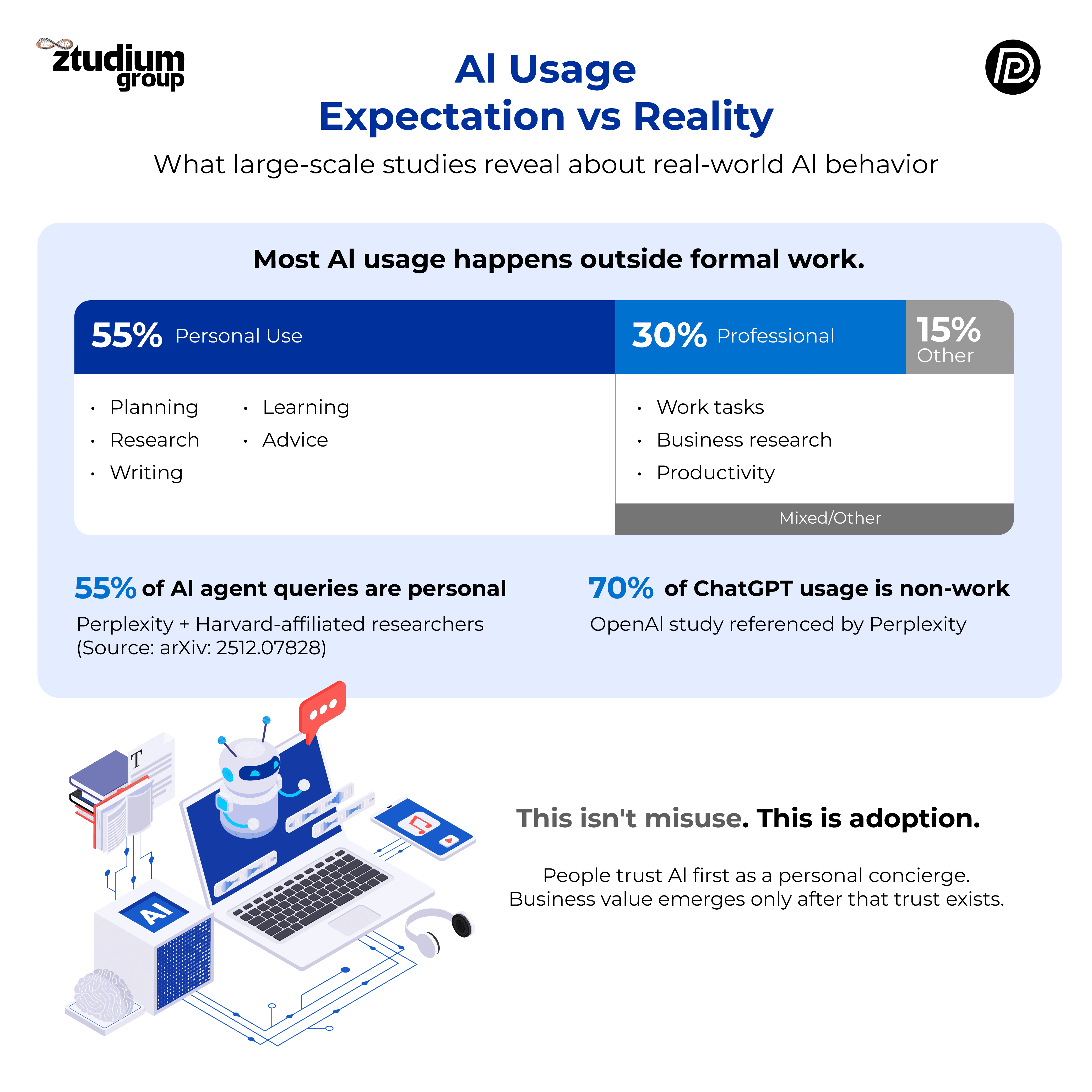
A September 2025 OpenAI study revealed something striking: nearly 70% of ChatGPT usage happens outside of work. People aren't primarily using AI to optimize workflows or hit KPIs—they're using it for emotional support, personal growth, curiosity, creativity, and everyday problem-solving.
This pattern raises a fundamental question: If people are building their relationship with AI around deeply human needs, why are institutions still designing AI systems as if efficiency and profit are intelligence's primary purpose?
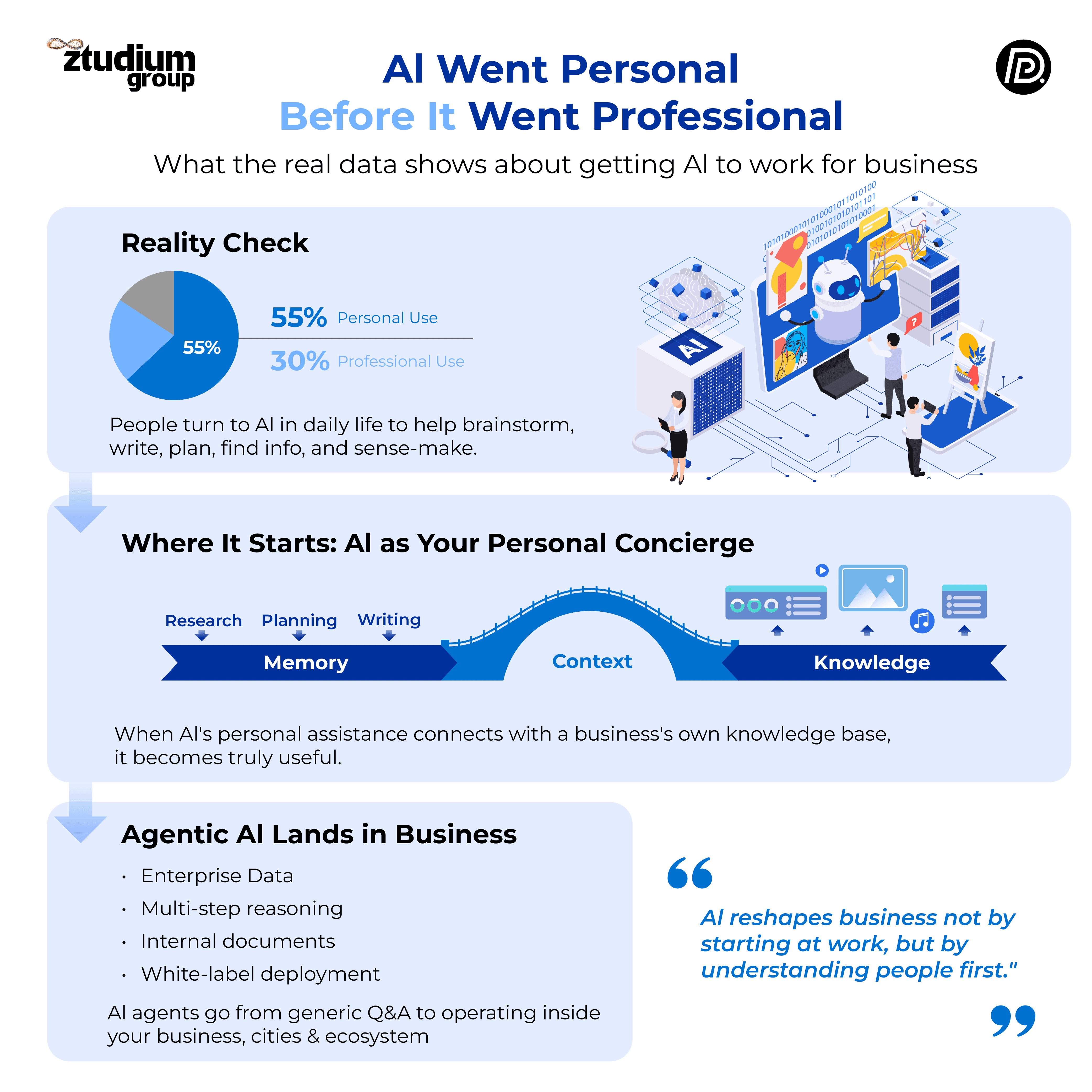
For years, the AI conversation has centered on workplace productivity, automating tasks, streamlining workflows, reducing manual labor. But recent research tells a different story. A study titled "The Adoption and Usage of AI Agents" from Perplexity and Harvard-affiliated researchers found that 55% of AI agent use is personal, while only 30% is clearly work-related. The pattern is consistent: people adopt AI in their personal lives first, then gradually bring it into their professional worlds. This isn't a bug in adoption patterns. It's a signal about what AI actually is.
AI as a Personal Concierge, Not a Corporate Tool
The Perplexity study reveals something important about how people interact with AI agents. They don't treat them like software, they treat them like personal assistants. People ask for help with research, summaries, planning, explanations, writing, and advice. Most significantly, they use AI for gathering information, reasoning, and decision support rather than simple task execution. In other words, people trust AI when it helps them think, not just when it helps them execute.
This mirrors my own experience. I don't use AI as a traditional productivity tool. It functions more as a personal concierge to accelerate research and fact-finding, draft and refine documents and narratives, explore and pressure-test ideas, design visual frameworks and infographics, and connect disparate signals across markets, technology, and policy. AI doesn't replace my thinking, it amplifies it. It shortens the distance between curiosity and understanding. That's exactly why it works.
Why Business AI Projects Fail
Most business AI initiatives don't fail because of weak technology. They fail because of flawed assumptions about usage. Businesses typically deploy AI as a workflow engine, a task automator, or a rigid system with predefined prompts. But people actually use AI as a reasoning partner, a context-aware assistant, and a conversational system rather than a command interface.
Industry leaders increasingly recognise this gap. NVIDIA’s Jensen Huang has described AI agents as the next major computing platform, systems that reason, plan, and act, not merely respond. Amazon's Andy Jassy emphasised that generative AI will reshape how organizations think and decide, not just how they operate. IBM and PwC both note that agentic AI adoption hinges on trust, context, and integration with organizational knowledge, not standalone tools. The Wharton AI Adoption Report confirms that the biggest benefits emerge when AI becomes part of decision-making processes rather than operating as a separate utility.
Bridging Personal and Professional AI
The question becomes: How does personal AI usage translate into business value? The answer lies in context and continuity. AI becomes genuinely useful when it understands how you reason, what constraints you operate under, what data matters to you, and how your organization thinks and communicates. Without this understanding, AI remains generic. This is why connecting AI frameworks to a business's proprietary knowledge base is critical.
At Citiesabc, we've built our platform around this principle. Our agentic framework doesn't just answer questions, it operates within an organization's proprietary context, drawing on internal documents, structured data, and institutional knowledge. As a white-label solution, it enables businesses, cities, and ecosystems to deploy AI agents that reflect their own intelligence rather than generic model assumptions. This distinction matters. The future of business AI isn't about replacing people, it's about helping more people understand more, faster.

What the Research Really Tells Us
One of the study's key findings is that people now rely on AI agents for complex thinking and information integration, not just simple queries. The Perplexity report also shows that people continue using agents who feel consistent, helpful, and aware of their needs. This creates a clear pattern: AI that feels "personal" earns trust, trust drives repeated use, and repeated use creates better outcomes.
The market is responding. Precedence Research indicates rapid growth in the agentic AI market as organizations move beyond chatbots toward more sophisticated, context-aware agents. PwC calls this shift "the new frontier in GenAI." But the winners won't be the systems with the most features. They'll be the ones that feel most human to work with.
From Productivity to Partnership
The biggest misconception about personal AI use is that it's somehow "less serious" than professional applications. The opposite is true. Personal usage is where trust is built, preferences are revealed, and thinking patterns emerge. That's why AI works best as a concierge initially. Organisations that embrace this reality will advance faster than those clinging to the productivity-tool paradigm.
The future belongs to AI systems that think with us, learn our context, operate within our knowledge, and evolve into partners rather than remaining mere tools. The data shows this future has arrived. We simply need to design AI for how people actually use it, not how we assumed they would.


