
first_page, citiesabc
Can We Create a Sea Curtain to Shield the 'Doomsday Glacier' from Melting?
09 Apr 2026

Planet Earth is a living, dynamic, and ruthless ecosystem. Most of it is water and ice. The total volume of water on Earth is estimated to be approximately 1.386 billion cubic kilometres (km³). The saltwater of oceans is roughly 97.5% of all water. The total of Freshwater: only about 2.5% of the total water on Earth is fresh.
The Global Ice Distribution is most part of that 2.5% of freshwater that is not liquid; it is locked away in glaciers and ice sheets. The Total Ice Volume: Approximately 27 to 30 million km³. On this the Percentage of Freshwater in Ice: About 69–70% of the world's freshwater is frozen.
The "99% Rule": Combined, the Antarctic and Greenland ice sheets contain more than 99% of all freshwater ice on Earth.
When it comes to ice, it does not negotiate. It does not read our human challenging reports, attend our tribal summits, or wait for our countries and political cycles. Planet Earth and its ice responds only to temperature and right now, the temperature is rising. Somewhere beneath the grey, churning waters of the Amundsen Sea, a process is underway that may redefine the coastlines of civilisation itself. Understanding it is not optional. It is, quite possibly, the most important question of our age.
What Is Antarctica's Rapidly Melting Thwaites Glacier?
To understand Thwaites, you must first understand scale. Not the polite, manageable scale of a political speech or a quarterly earnings report but the deep, geological scale of a planet that has been storing ice for millions of years, and is now beginning to let it go.
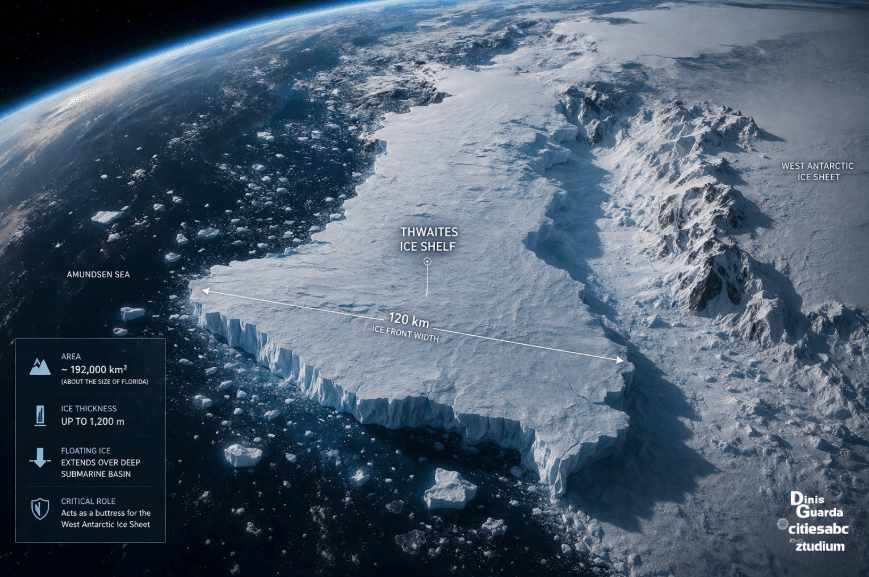
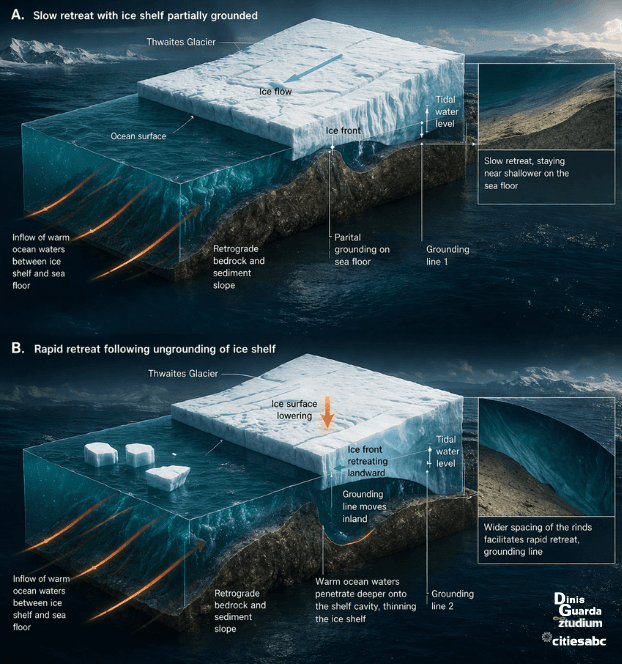
Thwaites Glacier sits at the edge of West Antarctica, a towering white fortress abutting the cerulean waters of the Amundsen Sea. It is the widest glacier on Earth, spanning 120 kilometres, roughly the width of Great Britain or the state of Florida, and in places its ice reaches a staggering 2,000 metres in depth. Across its vast surface, it contains enough frozen water to raise global sea levels by 65 centimetres if it were to collapse entirely. And beyond its own mass, it functions as the great cork in the bottle of the West Antarctic Ice Sheet, a natural dam holding back a further 2.35 metres of potential sea level rise from the glaciers that lie behind it.
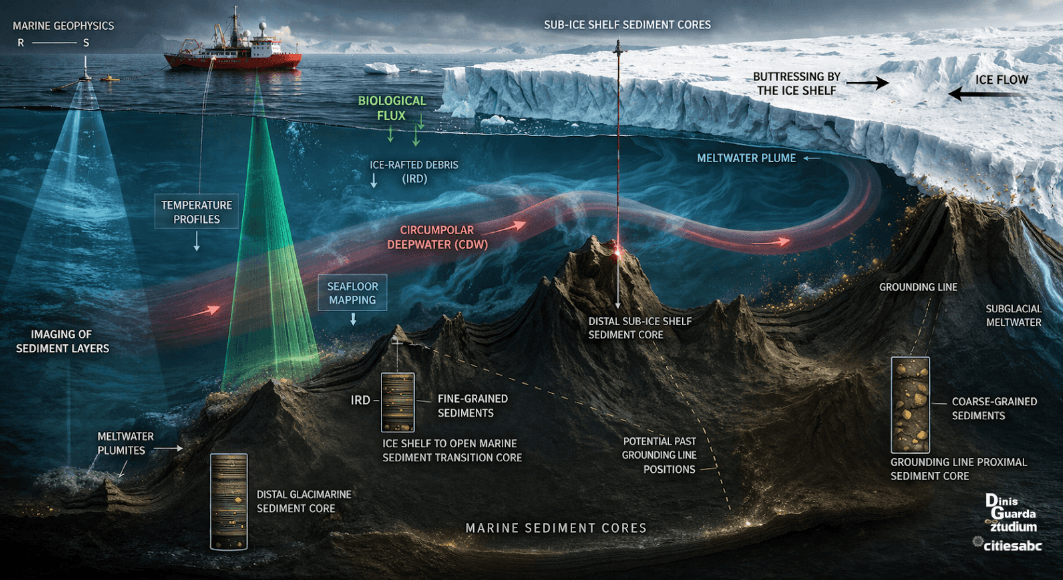
The physics of how Thwaites melts is as important as the fact that it melts. Unlike surface glaciers that shrink from above under a warming atmosphere, Thwaites is being consumed from below. Warm, salty Circumpolar Deep Water, a current that flows through relatively narrow channels along the continental shelf, intrudes beneath the glacier's floating ice shelf and attacks the grounding line: the critical point where the glacier meets the seabed. As that grounding line retreats, more ice becomes afloat, more surface is exposed to warm water, and the collapse accelerates. It is a self-reinforcing feedback loop with no natural brake.
For three decades, satellites have measured the consequences. Between 1992 and 2011, the grounding lines of Thwaites and its neighbour Pine Island Glacier retreated dramatically — data documented in landmark research by Eric Rignot and colleagues at NASA and published in Geophysical Research Letters (2014). By 2024, a further study by Rignot's team in the Proceedings of the National Academy of Sciences confirmed widespread seawater intrusions beneath the grounded ice itself, a finding that alarmed even veteran polar scientists. The glacier is currently shedding approximately 50 billion metric tonnes of ice every single year, contributing to roughly four per cent of all global sea level rise worldwide.
Underlining just how urgent the data has become: the Antarctic Research Trends Report 2025, published by UArctic and Umeå University (Zenodo, 2025), analysed global patterns in Antarctic and Southern Ocean academic publishing from 2016 to 2024 and found a measurable acceleration in research output, a scientific community quietly, urgently, racing the clock. John Moore, Research Professor at the University of Lapland and lead of the UArctic Thematic Network on Frozen Arctic Conservation, the scientific backbone of the Seabed Curtain Project, frames the stakes with characteristic directness:
It would be a giant project but then we face a gigantic problem.
Thwaites is not merely a scientific concern. It is a critical element for the survival of our present civilisation.
Why Is It Called the Doomsday Glacier?
The name Doomsday that was recreated from Thwaites did not come from sensationalism. It came from mathematics. When scientists, glaciologists, began modelling the full cascade of consequences should Thwaites destabilise beyond recovery, the arithmetic was so stark, so irreversible, and so vast in its human consequence that the informal epithet attached itself permanently. The Doomsday Glacier. And the closer scientists look, the more the name earns its gravity.
The scenario that haunts the science runs like this: Thwaites reaches a point of marine ice sheet instability, a threshold after which retreat becomes self-sustaining regardless of what happens to atmospheric temperatures above. Its collapse removes the buttressing force that holds back the broader West Antarctic Ice Sheet. Other glaciers, Smith, Pope, Kohler, Pine Island, follow into the warming sea. Global mean sea level rises not by centimetres but by metres, on timescales of decades to centuries, with consequences that no human engineering has ever been built to absorb.
Hilmar Gudmundsson of Northumbria University, co-author of a 2023 study in The Cryosphere on the stability of the West Antarctic Ice Sheet, has watched the scientific consensus shift from uncertainty to near-certainty. He told The New York Times:
We have gone from a stage of 'we don't know' to 'an almost certainty' that it will collapse
With fossil fuel emissions reaching record levels in 2025, the sixth consecutive year of rising global temperatures, nations, as the science makes plain, are not on track to prevent it through decarbonisation alone.
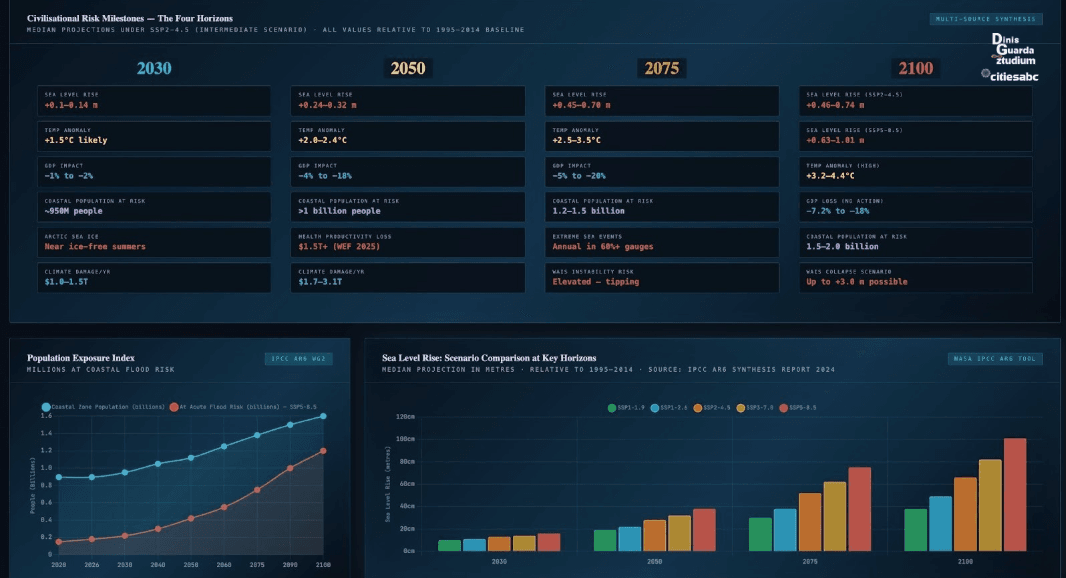
Each centimetre of sea level rise exposes approximately six million additional people to coastal flooding worldwide. The mathematics of Thwaites' full collapse, 65 centimetres of rise from this glacier alone, translates to roughly 390 million people placed in jeopardy. Should the wider West Antarctic system follow, the number climbs toward the billion-mark. These are not projections to be debated in seminar rooms. They are incoming events to be planned for, or, if we are bold enough, intervened against.
The title "Doomsday Glacier" is not hyperbole. It is a warning encoded in the language of science, written in ice that has been melting for thirty years while the world watched.
Why We Need to Take This Seriously
There is a particular human habit, one Plato identified in The Republic and Seneca lamented in his letters — of treating the distant catastrophe as an abstraction. When the threat is too large, too slow, or too geographically remote, the mind deflects. This is the precise psychological architecture that the climate crisis exploits, and nowhere more fatally than in discussions about Thwaites.
The data is not abstract. The IPCC Sixth Assessment Report (2021–2024) places global mean sea level rise at between 0.63 and 1.01 metres by 2100 under the high-emissions scenario and those figures do not fully account for the low-likelihood, high-impact processes involving rapid Antarctic ice sheet collapse. The IMF, in its Working Paper on the long-term macroeconomic effects of climate change (Kahn et al., 2019), calculates a 7.22 per cent reduction in world real GDP per capita by 2100 under the business-as-usual scenario. The Swiss Re Institute, in its 2021 report The Economics of Climate Change, warns of up to 18 per cent of global GDP lost by 2050 at 3.2°C of warming. The World Economic Forum and Boston Consulting Group projected in 2025 that climate-driven health impacts alone could cost $1.5 trillion in lost productivity before mid-century.
These are not projections from activists. They are calculations from central bankers, reinsurance underwriters, and the most rigorous scientific institutions on Earth. They demand to be taken seriously not merely as policy inputs, but as moral imperatives.
The urgency is sharpened further by the discovery that in 2025, warm Circumpolar Deep Water was measured surging past a natural underwater ridge that had previously acted as a partial barrier, a natural prototype of the very structure that the Seabed Curtain Project is now proposing to build artificially. The loss of that natural barrier is, in itself, an alarm bell. Nature offered a proof of concept; nature is now dismantling its own demonstration model.
Professor David Holland of New York University, one of the world's foremost Thwaites researchers and a collaborator on the Seabed Curtain Project, has made eight expeditions to the glacier. He once dismissed the idea of a sea curtain as impossible. He no longer does.
Can you put in a curtain and save the coastline of the world? I would have said, 'No way,' two years ago." But now, he says it's doable — at least from a scientific perspective. "At some point, you just have to ask, 'Is it plausible?' Because if you're against it, then what are you against? Some unforeseen consequence that's going to destroy the Earth? Well, maybe that's what's happening right now.
That moral weight, the possibility that inaction is itself the catastrophe, is why this deserves not curiosity but commitment.
Thwaites Glacier: The Doomsday Numbers
Thwaites Glacier stretches 120 kilometres across West Antarctica, wider than the state of Florida, roughly the size of Great Britain, and contains ice equivalent to 65 centimetres of global sea level rise. It is the linchpin of the West Antarctic Ice Sheet. Should it destabilise entirely, it could expose the remainder of the ice sheet, holding a further 2.35 metres of potential sea level rise, to runaway collapse.
Indicator | Current Data | Collapse Scenario |
| Annual ice mass loss | 50 billion metric tonnes/yr | Accelerating |
| Contribution to sea level rise | 4% of global annual rise | Up to 3 m (full WAIS) |
| Sea level rise if fully collapsed | — | 65 cm from Thwaites alone |
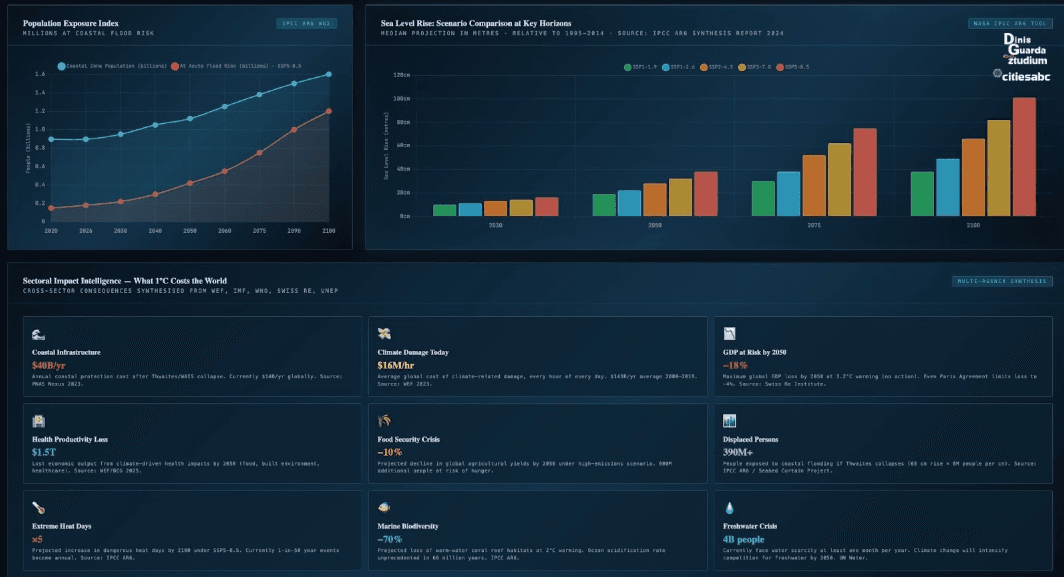
| People exposed per cm of rise | 6 million globally | 390 million+ (65 cm) |
| Global sea level rise since 1880 | 21–24 cm | Rate accelerating |
| Cost of curtain project | $40–80 billion | vs. $40B/yr coastal protection |
Source: PNAS Nexus (2023), Keefer, Wolovick & Moore; Rignot et al. (2024), PNAS; British Antarctic Survey (2026).
The Consequences for the World
Imagine the Maldives: an archipelago of 1,200 islands, the highest point barely two metres above sea level, home to more than half a million people and one of the most extraordinary marine ecosystems on Earth. A 65-centimetre rise in sea level does not merely inconvenience the Maldives. It erases them. Now multiply that story across the Pacific Island nations, Tuvalu, Kiribati, the Marshall Islands and you have the first civilisations in human history threatened not by war, famine, or disease, but by a glacier in Antarctica they have done almost nothing to destabilise.
The consequences radiate outward in concentric rings of devastation. The great coastal megacities, Mumbai with 21 million people, Shanghai with 26 million, Ho Chi Minh City, Miami, Jakarta , face inundation of infrastructure, disruption of financial systems, and the displacement of populations on a scale that no refugee protocol in history has been designed to manage. A 2022 report to NOAA projected a plausible range of global mean sea level rise between 0.3 and 2.0 metres by 2100. The upper end of that range, combined with storm surge, would render large portions of lower Manhattan, South Miami Beach, and coastal Bangladesh uninhabitable within the lifetimes of children born today.
The economic toll is equally staggering. The peer-reviewed work of Keefer, Wolovick and Moore, published in PNAS Nexus in 2023, estimates the annual cost of coastal protection following Thwaites and Pine Island Glacier collapse at approximately $40 billion per year, every year, indefinitely. The cost of the seabed curtain, by contrast, is estimated at $40–80 billion total, with $1–2 billion per year in maintenance. The arithmetic is not merely compelling; it is overwhelming. As Hagen has stated plainly:
The cost of this project will run in billions. The cost of the damages will run into trillions.
Beyond the economic, the ecological consequences reshape the very chemistry of ocean systems. As warm water penetrates the Southern Ocean, marine food webs that have evolved over tens of millions of years are disrupted. The loss of Antarctic krill, the keystone species underpinning penguin, whale, and fish populations across the Southern Hemisphere, ripples through global fisheries. Ocean acidification, accelerated by warming, bleaches coral reefs from the Great Barrier to the Caribbean. The biological cost of Thwaites' collapse is not merely a loss of wilderness. It is the dismantling of the living systems that regulate oxygen, food, and climate for the entire biosphere.
Each human being is part of the big puzzle that is humanity. The tide rising in the Sundarbans delta of Bangladesh is the same tide that will lap at the steps of the Sydney Opera House, the Thames Barrier, the seawalls of Venice. The ocean does not honour borders.
Summary, Conclusion, and the Solution: The Seabed Curtain Project
In every epoch of civilisation's greatest crises, from the engineering of Rome's aqueducts to the wartime mobilisation of industrial democracies, humanity has found that the difference between catastrophe and survival is not the absence of the problem but the presence of will. The Seabed Curtain Project is, in the most precise sense, an act of will.
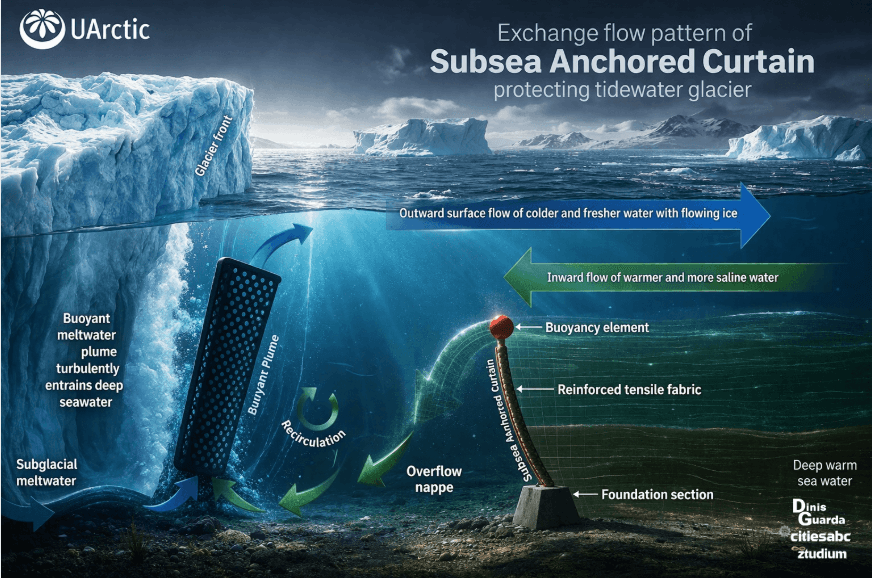
The concept originated in the work of John Moore and Michael Wolovick, who in 2018 proposed blocking the underwater pathways delivering warm water to the glacier and has since evolved into a rigorous, peer-reviewed, multi-institutional engineering programme. The core proposal: a flexible, buoyant membrane, 80 kilometres long and 152 metres high, anchored to the seabed at 650 metres depth in front of Thwaites Glacier, specifically in the Pine Island Trough of the Amundsen Sea. Its upper edge would trail below the ocean surface, allowing icebergs to pass unimpeded, while physically interrupting the Circumpolar Deep Water that drives the glacier's destruction. The anchor points align with a submarine moraine, a natural ridge beneath the Amundsen Sea, which fieldwork led by Professor Holland aboard the South Korean vessel RV Araon confirmed in January 2026 as a viable engineering foundation.
The project is an initiative of the University of the Arctic (UArctic), a collaborative network of over 200 universities and research institutions across the circumpolar North, and is funded by Outlier Projects and the Tom Wilhelmsen Foundation. Its research consortium spans Cambridge University, the University of Chicago, New York University, the Alfred Wegener Institute, Dartmouth College, NIVA, and Aker Solutions. As Sasha Post, Director of Outlier Projects, has stated:
Sea level rise is one of the most serious climate risks facing humanity this century. It is essential to accelerate research, like UArctic's seabed anchor curtains project, to evaluate how to safely manage this risk. (seabedcurtain.org)
Co-leading the project is Marianne Hagen. former Deputy Minister of Foreign Affairs of Norway, who came to work with UArctic from the position of Executive Vice President of Aker Solutions, and who has an extensive career in politics and as a board member of publicly listed companies. Her voice in this project carries weight well beyond the scientific: it is the voice of someone who has sat in rooms where civilisation-scale decisions are made, and who has chosen to stake her credibility on this one.
Just because it's extremely difficult is not an excuse not to try," she told IFLScience. "For me, it's kind of a no-brainer. If it's possible to take 65 centimetres of global sea level rise off the table for everybody, with one single targeted intervention in one location, I'm willing to explore it. I think we have an obligation to do so.
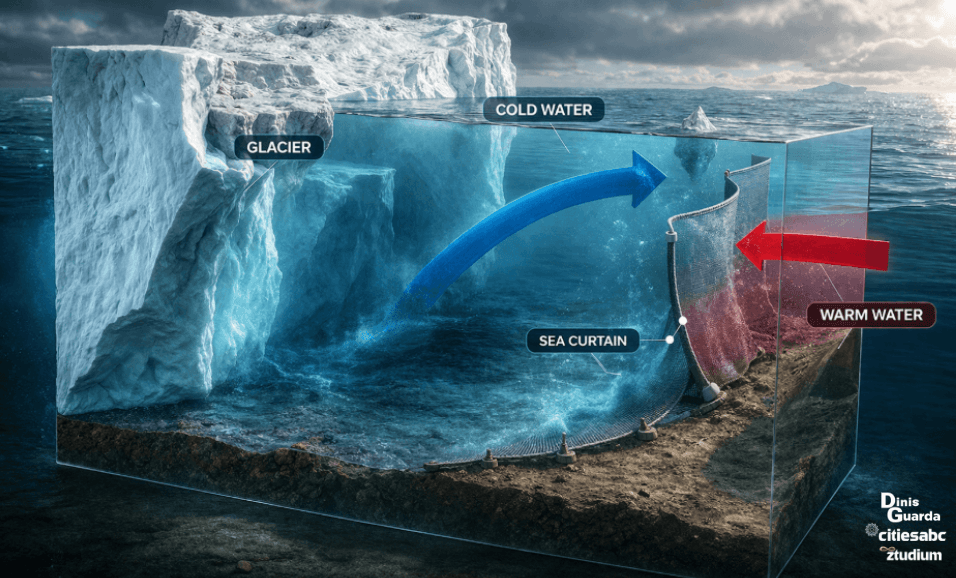
The Seabed Curtain Project is an international project supported by the University of the Arctic, a cooperative network of nearly 200 universities and research institutions. The project has obtained funding from the Tom Wilhelmsen Foundation, the charitable arm of Norwegian shipping giant Wilhelmsen, and Outlier Projects, a philanthropic organization created by former Meta chief technology officer Mike Schroepfer, which gives grants to research groups working on climate tech interventions.
The project is a critical endeavour that is among a handful of proposals that scientists have put forward in a last-ditch effort to preserve the rapidly melting polar regions. These include drilling holes to the glacier bed to drain the water that lubricates the glacier's outward flow, and refreezing Arctic sea ice by pumping up water from below onto the ice. One study also found solar geoengineering, known as stratospheric aerosol injection, might be able to save the West Antarctic Sheet.
However, these projects, which fall into the realm of geoengineering, have received fierce pushback from some polar scientists. This month, 42 polar scientists — from institutions such as the British Antarctic Survey, Scripps Institution of Oceanography, and International Cryosphere Climate Initiative — published an assessment of five polar geoengineering projects currently in development in the journal Frontiers in Science, titled "Safeguarding the polar regions from dangerous geoengineering." The group concluded that the proposed geoengineering projects would cost billions of dollars in setup and maintenance, and argued they would reduce pressure on policymakers and industries to slash greenhouse gas emissions. Additionally, the assessment looked at the ecological, legal and political obstacles in advancing these ideas.
The roadmap is precise and disciplined. In the first phase, mooring data retrieved from the Thwaites region feeds into engineering models for materials selection and curtain design. A prototype — 150 metres long and 40 metres high — is planned for testing in Ramfjorden, near Tromsø, Norway, in 2027. The project's ambition is to present, within fifteen years, a foundation for a deployment decision grounded in peer-reviewed science, proven technology, and a governance framework within the Antarctic Treaty System. The current fundraising target is $10 million for Phase 1. Hagen is unsentimental about the engineering sequencing:
It would be absolutely insane, from an economic perspective, to go straight to Thwaites and start building something. We need to test this at a much lower cost, in less harsh conditions.
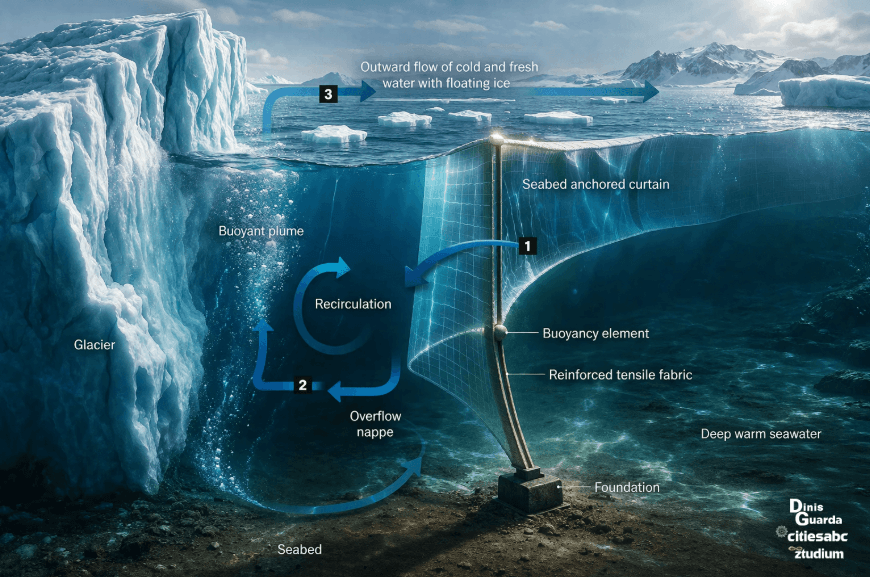
The Seabed Curtain Project is explicit that the curtain is not a licence to abandon decarbonisation. It is not a substitute for the Paris Agreement. It is not a technological escape hatch that relieves governments of their obligations to cut greenhouse gas emissions. It is a bridge, a means of buying the decades that emissions reduction efforts, even at their most ambitious, cannot deliver fast enough to save the ice. As the project's own documentation states, reducing warming through emissions reductions or solar radiation management will not alone be enough to stabilise the ice sheets. The physics, at this point, demands a physical response. Hagen herself draws the line clearly:
I could not see a safe pathway forward for future generations without doing the necessary research on these Band-Aid, buy-time solutions." And she is equally clear on what comes first: "I truly believe that reducing emissions is what's going to save the planet. There is no way around it, with or without any climate interventions.
This is the moment that defines what kind of civilisation we choose to be. The question before humanity is not whether we can afford the Seabed Curtain. The peer-reviewed economics answer that: we cannot afford to be without it. The question is whether we will act with the urgency, the international solidarity, and the engineering ambition the moment demands — before the glacier answers the question for us, in a language written in rising water.
Antarctica's Thwaites Glacier, often referred to as the Doomsday Glacier, is currently shedding 50 billion metric tonnes of ice each year. The complete collapse of this glacier could result in a 65-centimetre rise in global sea levels, endangering hundreds of millions of lives and potentially triggering a series of failures across the West Antarctic ice sheet, leading to a total sea level rise of up to 3 metres. Even a small increase in sea levels, just one centimetre, can expose an additional six million people to the risk of coastal flooding.
To address this pressing issue, the Seabed Curtain Project has put forth an innovative and super urgent solution: a flexible barrier stretching 80 kilometres and standing 152 metres high, anchored at a depth of 650 metres in front of Thwaites. This structure aims to divert Circumpolar Deep Water away from the glacier's grounding line, providing critical time — potentially decades — for emissions-reduction efforts to take root.
The ice is watching. And so, now, it is up to us — and how do we prepare the world for ourselves and our present and next generations.
The ocean is not merely rising; it's on the brink of a rapid acceleration. We aren't just observing a tide; we're poised to witness a civilisation-scale threat unfold before our eyes in the near future.
Key Sources & References
- Seabed Curtain Project (2025–2026). Project Overview and Scientific Framework. seabedcurtain.org
- University of the Arctic (UArctic) (2025–2026). Seabed Anchored Curtain Initiative. uarctic.org
- Keefer, B., Wolovick, M., & Moore, J. C. (2023). Feasibility of ice sheet conservation using seabed anchored curtains. PNAS Nexus, 2(3). doi:10.1093/pnasnexus/pgad053
- Moore, J. C., Macias-Fauria, M., & Wolovick, M. (2025). A new paradigm from the Arctic. Frontiers in Science, 3, 1657323. doi:10.3389/fsci.2025.1657323
- Rignot, E., Ciracì, E., Scheuchl, B., & Dow, C. (2024). Widespread seawater intrusions beneath the grounded ice of Thwaites Glacier. Proceedings of the National Academy of Sciences, 121(22), e2404766121.
- Rignot, E., Mouginot, J., et al. (2014). Widespread, rapid grounding line retreat of Pine Island, Thwaites, Smith and Kohler glaciers, 1992–2011. Geophysical Research Letters, 41(10).
- Van den Akker, T., et al. (2025). Present-day mass loss rates are a precursor for West Antarctic Ice Sheet collapse. The Cryosphere, 19(1), 283–301.
- IPCC AR6 Synthesis Report (2024). Climate Change 2021–2023: The Physical Science Basis and Impacts. Cambridge University Press.
- Mongabay (September 2025). Scientists weigh giant sea curtain to shield 'Doomsday Glacier' from melting. news.mongabay.com
- Euronews Green (February 2026). Doomsday Glacier is melting faster than we thought. Can a 150-metre wall stop it flooding Earth? euronews.com
- Interesting Engineering (February 2026). 50-mile underwater wall proposed to slow 'Doomsday Glacier' melt. interestingengineering.com
- Impakter (February 2026). Underwater Wall to Protect the 'Doomsday Glacier'. impakter.com
- Kahn, M. E., et al. (2019). Long-Term Macroeconomic Effects of Climate Change. IMF Working Paper WP/19/215.
- Swiss Re Institute (2021). The Economics of Climate Change: No Action Not an Option.
- WEF / Boston Consulting Group (2025). Building Economic Resilience to the Health Impacts of Climate Change.
- Scientists weigh giant sea curtain to shield ‘Doomsday Glacier’ from melting, By Gloria Dickie, 24 Sep 2025, Antarctica https://news.mongabay.com/2025/09/scientists-weigh-giant-sea-curtain-to-shield-doomsday-glacier-from-melting/


