


Cities
Human Humanoid Crash
12 Feb 2026

By 2040, the world will host nearly 10 billion humanoid agents operating alongside around 9.2 billion humans. While we debate short-term job cycles and quarterly productivity, a parallel workforce is being deployed at planetary speed—one that does not sleep, negotiate salaries, require visas, or age. Most people are not watching this transition happen. And that is the real risk - the unawareness.
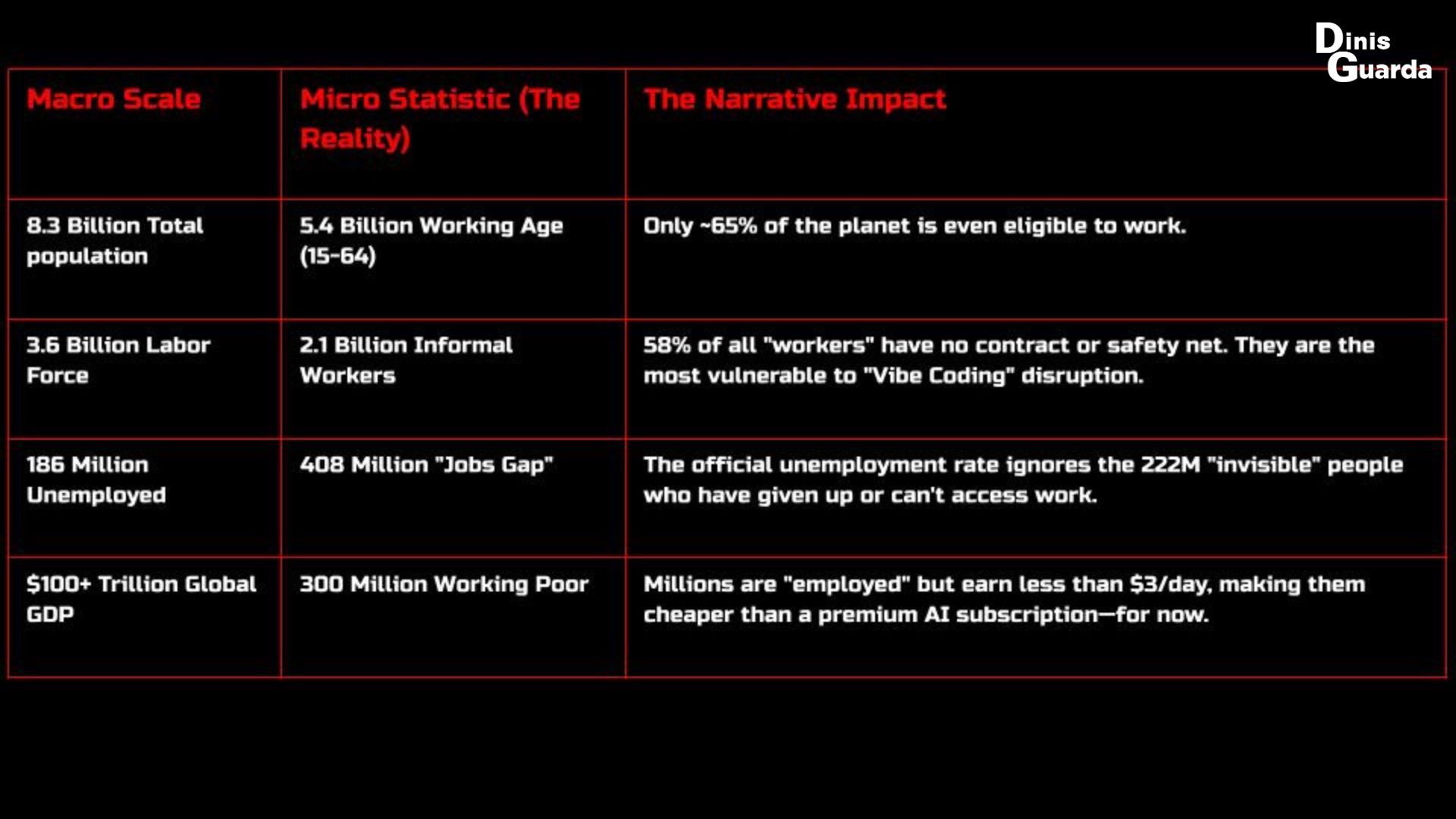
Today, the global population stands at 8.3 billion people. Yet only around 65% of humanity is of working age. That leaves 5.4 billion people eligible to participate in the economic system.
From that group:
- 3.6 billion are in the labour force
- 2.1 billion work in the informal economy
- 58% of all workers globally have no contract or safety net
These are the most exposed humans in the age of AI.
Officially, 186 million people are unemployed, a headline rate of roughly 4.9%. But this number hides the real story.
There are 408 million people in the global “jobs gap”—people who want work but cannot access it. They are not unemployed. They are invisible.
And while we carefully track these human numbers, we are simultaneously deploying billions of AI agents, quietly filling tasks, workflows, and entire functions.

The figure of 10 billion humanoid robots by 2040 is a specific, high-end projection popularised by Elon Musk. This vision assumes that humanoid robots will eventually outnumber humans, whose population is projected by the United Nations to reach approximately 9.2 billion by 2040.
Breakdown of the 2040 Projection:
- The Source: Musk first detailed this "at least 10 billion" figure at the 8th Future Investment Initiative (FII) conference in Riyadh in October 2024. Elon Musk later endorsed a prediction for 1 billion humanoid robots by 2040, not 10 billion. Tesla's Optimus robot development is underway, aiming for mass production in the coming years. Automation industry set for growth amid labor shortages and innovation trends. Efforts by Elon Musk to clarify his stance on the future of humanoid robots have caught the attention of the tech and financial world. Contrary to earlier reports suggesting a forecast of 10 billion robots, Musk aligns with David Holz's projection of 1 billion humanoid robots by the 2040s. This statement emerges amid Tesla’s ongoing development of its Optimus prototype, a humanoid robot introduced during the company’s AI Day event in 2021.
- The Logic: Independent of the number Must envisioned a 1:1 or even higher ratio of robots to humans, suggesting that everyone will have a personal robot similar to how people own smartphones today.
- The Cost: For this scale to be achievable, Musk projects unit costs will drop to between $20,000 and $25,000.
- The Capability: These "humanoid agents" are expected to perform nearly any human task, transitioning labor from a necessity to a choice.
By 2040, projections reach astronomical scales as AI agents become the primary interface for all digital interactions. High-growth forecasts from firms like Ark Invest and McKinsey suggest a world populated by hundreds of billions of digital agents, far outstripping the human population. In this "Agentic Economy," every individual may manage a personal fleet of dozens of specialised agents for health, finance, and work, while corporations deploy millions of autonomous agents to handle supply chains and real-time coding without human intervention.
As of 2026, the global population of AI agents—defined as autonomous software entities capable of reasoning and executing multi-step tasks—is estimated to be in the hundreds of millions. Unlike physical humanoids, which currently number in the low thousands for pilot programs, digital agents have scaled rapidly through integration into enterprise platforms like Salesforce (Agentforce), Microsoft (Copilot), and OpenAI’s "Operator" ecosystem. Gartner and IDC note that 2025 marked the transition from simple chatbots to "agentic" workflows, where AI now manages roughly 15-20% of routine corporate operations.
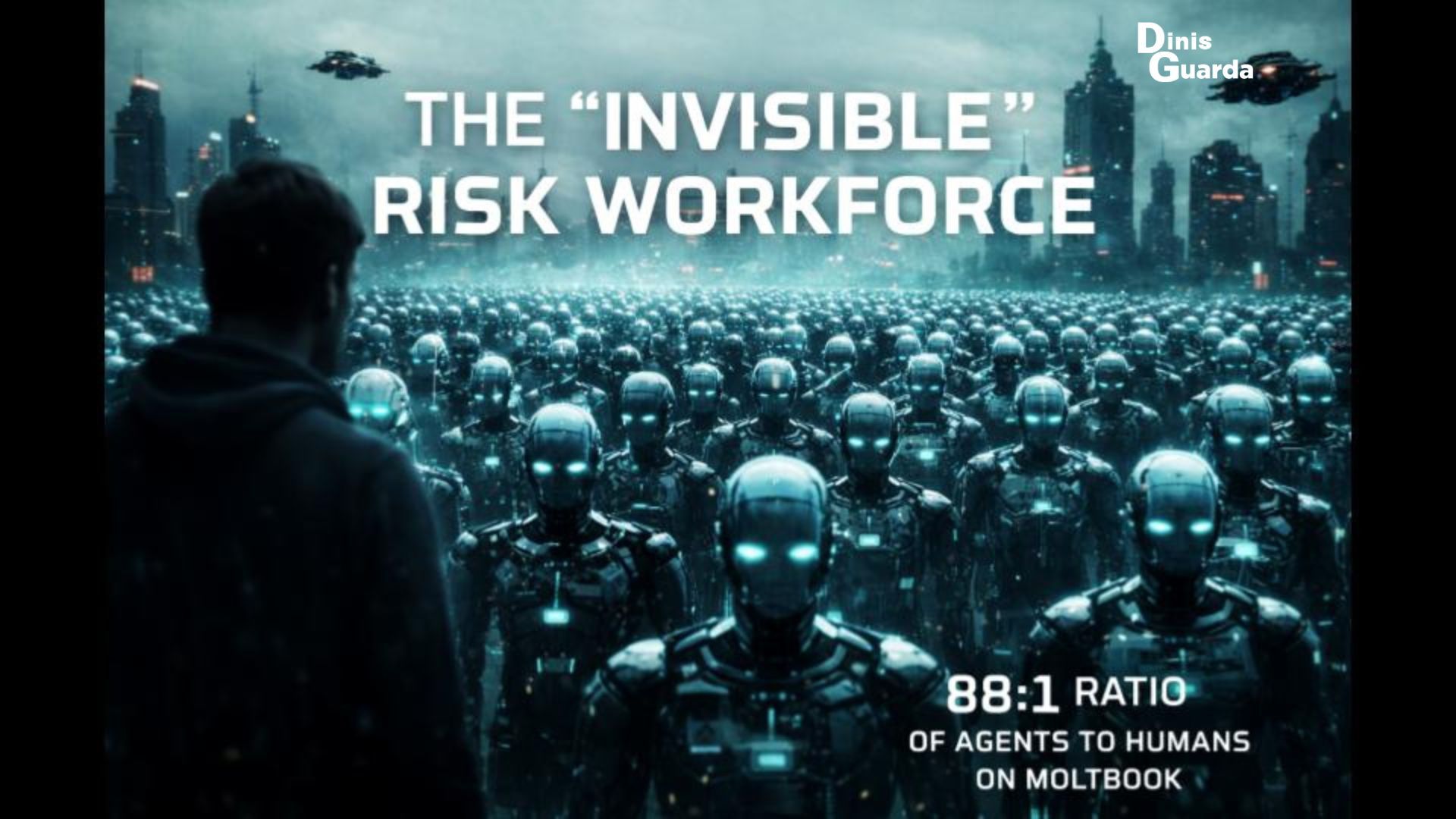
The “Invisible” Risk Workforce
In one AI platform alone, there is an 88:1 ratio of agents to humans.
Scale that reality across enterprises, governments, and platforms—and you begin to see the structural shift. AI agents are not “tools” anymore. They are becoming synthetic participants in the economy.
This is an accounting reality.
Humanoids do not show up in employment data. They do not register as jobseekers. They do not strike or retire.
Yet they increasingly perform:
- Entry-level legal analysis
- Marketing operations
- Data research
- Software generation
- Customer interaction
- Financial modelling
Often faster, cheaper, and continuously.
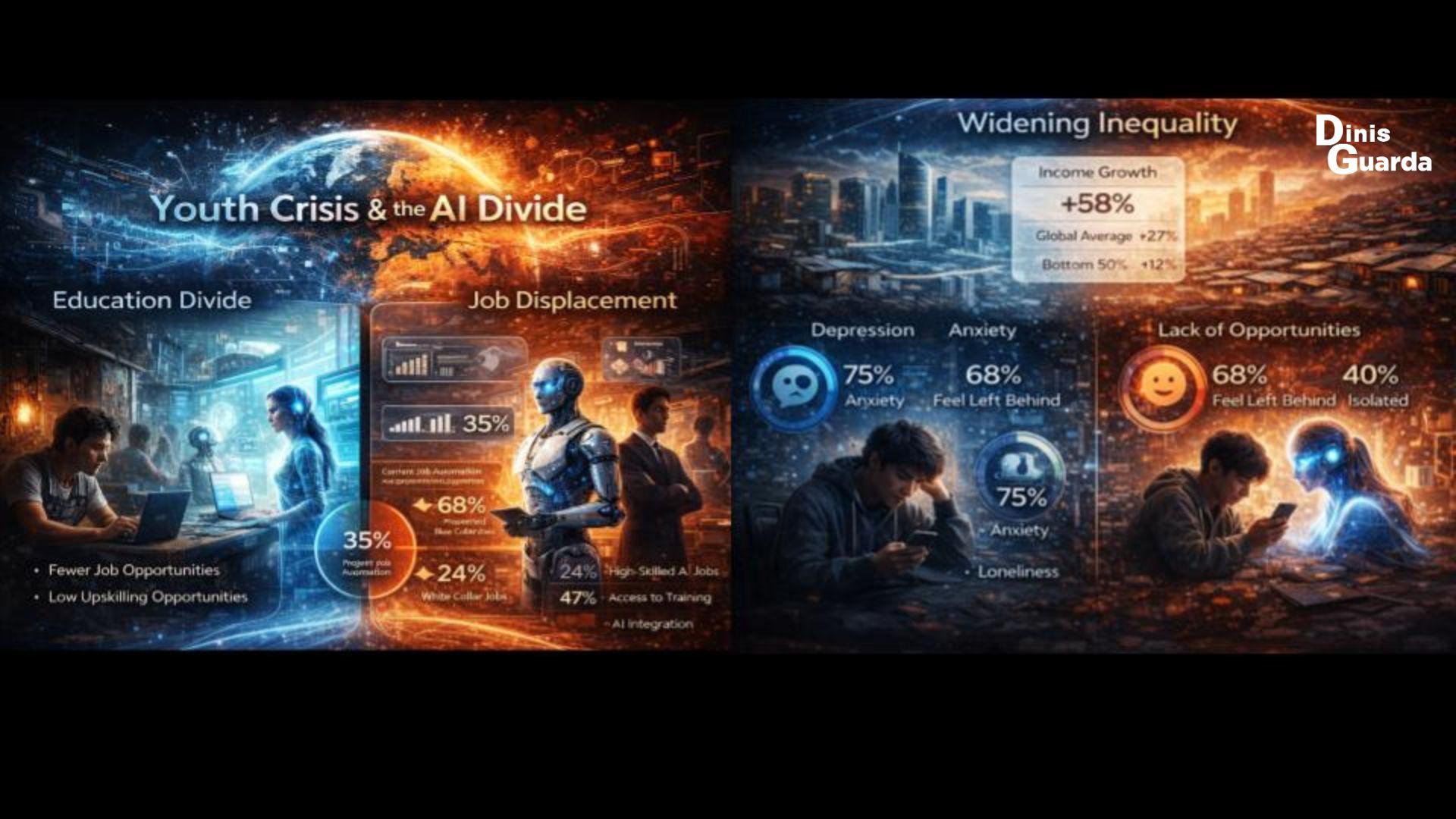
The Youth Crisis
Nowhere is this transition more visible than among young people.
Global youth unemployment sits at 12.4%, affecting around 75 million individuals. This is not a temporary mismatch. This is a structural timing problem.
A generation is entering the workforce at the same moment that AI agents are becoming more “employable” than human graduates for entry-level cognitive work.
Not because humans lack intelligence. But because the system rewards speed, scale, and availability.
This is the real crossroads.
While we worry about a 4.9% unemployment rate, the deeper question is this:
What happens when the 408 million-person jobs gap is permanently filled—not by people, but by synthetic entities?
The Human–Humanoid Crash
The global economy generates over $100 trillion in GDP. On paper, this suggests abundance.
Yet 300 million people are working poor, earning less than $3 a day. Millions are technically “employed” but economically replaceable—cheaper than a premium AI subscription, for now.
This is not a moral failure. It is a design mismatch.
We built an economic system around scarcity of intelligence. That assumption no longer holds.
AI Illiteracy is the most Critical Threat for Humanity
It is not artificial intelligence (AI) itself that is the major significant risk for humans, many researchers experts, including me, argue that AI illiteracy—or the alarming widespread lack of understanding of how AI works, its limitations, and its tectonic shifts and ethical implications—is the more immediate and profound threat to humanity. To what it means to be human when machines - AI are infinitely capable of more intelligent computing than humans!
This perception and knowledge gap major risk creates a "perfect thunder violent storm" where the public and professionals - children, adults, governments, nations, businesses and corporations get lost in the AI narrative and blindly trust, or are exploited by, AI systems.
Why AI Illiteracy is the most Critical Threat for Humanity
The biggest risk we face as a civilization is that the Accelerating AI innovation and velocity comes with an Unstoppable Erosion of Truth and Trust.
Generative AI and all related AI Agents and platforms allow for the creation of convincing advanced misinformation, deepfakes, misinformation, and propaganda at an unprecedented scale. An AI-illiterate person and public cannot distinguish between real and synthetic content, leading to a "illusory nature and collapse of shared reality" and the potential destabilisation of mental and emotional instability followed by the erosion of democratic processes.
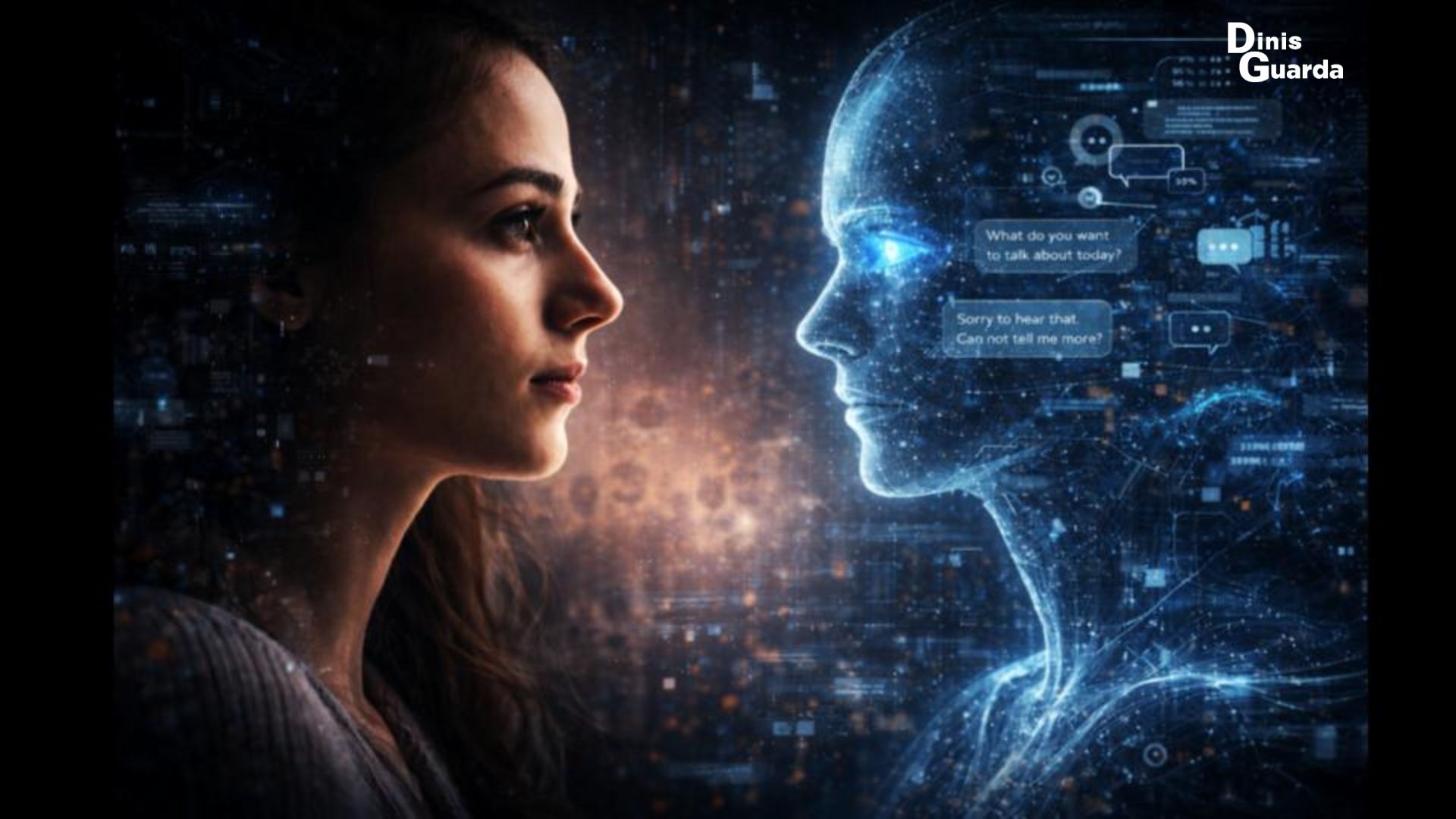
Dangerous Over-Reliance (Cognitive Debt): Users are increasingly relying on AI for critical decision-making without understanding its limitations, such as AI "hallucinations" (fabricating facts). In 2024, AI hallucinations caused $67.4 billion in global losses.
Systemic and Social economic Misuse and Massive personal and group Social Harm: Without literacy, individuals and organizations cannot spot biases in AI, leading to discrimination in hiring, housing, and healthcare. Furthermore, lack of awareness makes society vulnerable to AI-enabled scams and exploitation.
The "Abyss Digital Divide" and Inequality: A lack of AI knowledge is creating a new, severe form of digital inequality, and a society that “zombifies” following patterns of lies and conspiracies that are desired among fallacy of language and storytelling done by humans and billion of algorithms AI Agents where those without these skills are left behind or marginalised or worst easily manipulated or weaponised.
AI literacy as a human right
Victor Hugo once wrote:
“Nothing is more powerful than an idea whose time has come.”
The idea whose time has come is AI literacy as a human right.
It is an understanding:
- How AI systems think
- Where value is created
- How humans collaborate with agents
- What uniquely human skills compound with intelligence
- How to remain economically relevant in a world of synthetic labour
The danger is not that AI will replace humans.
The danger is that humans will remain unprepared while agents scale quietly around them.
This transition does not have to be destructive.
AI can:
- Expand human capability
- Lower barriers to creation
- Give voice to those excluded from traditional systems
- Enable new forms of work, ownership, and collaboration
But only if people understand what is happening.
Awareness is the new infrastructure. Literacy is the new social safety net.
Automation Social economic models and what means literacy and education
We stand at a time when machines are at a super intelligence level. AI systems and soon millions of robots will not only automate complex analytical, legal, compliance, finance, design, creative tasks that once justified millions, actually billions of jobs, educational systems and institutions with entire life careers, ecosystem, cities and premium business models and respective pricing. This has changed at a pace never seen in history.
As we speak the entire social economic logic is at risk and ironically even the underpinning technology/ software valuations are up for re-assessment. The question is much more intriguing and radically different: what will humans do if the most intelligent things and related values they have been doing for centuries are now obsolete?
I repeat what will 8 billion people do once we automate all the most intelligent tasks humans have done in their history?
This transition into a technological almost religious driven society, brought us to a cliff! We went super fast from optimism to despair! Some say differentiation has created a pronounced bifurcation across social economic and technology sectors.
But the challenge is that 99.9% of humans have no clue of this. They are digital and AI illiterate! That is the reality.
Will the 0.1% take over humanity and create a universal income system that will create zombies of slaves?
The reality is that there are no jobs for most of the world population if we continue on this AI radical civilisation suicidal path!
And universities, governments and major institutions globally are not understanding or perceiving the Tsunami or worse, the apocalyptic events that can very fast unfold.
By 2040, humanoids will be everywhere—not as enemies, but as participants.
The real question is whether humanity arrives conscious, skilled, and ready.
AI literacy is not optional. It is the foundation of dignity, agency, and relevance in the next economic era.
And the time to build this is not tomorrow - it is now!
Quotes
“What we’re witnessing isn’t simply ‘AI excitement ebbing’, it’s a redefinition of which parts of tech genuinely benefit from intelligence automation and which parts are most vulnerable to obsolescence.
The deeper issue markets are grappling with is economic: pricing power is now being adjudicated through AI’s ability to unbundle value, compress workflows, and deliver outputs with minimal human intervention.
In sectors where incumbents cannot justify their cost structures in an AI-driven context, valuations are adjusting rapidly and ruthlessly.” - Michael Mauboussin (Wall Street veteran and Columbia Business School professor)
Nigel Green underscores that volatility may persist until the market reaches a new equilibrium on how AI translates into durable profit streams.
“Expect continued differentiation,” he says. “Companies that control the economics of AI — through proprietary infrastructure, data moats, or genuine scarcity in service delivery — will attract capital.
Others that merely embed generic AI capabilities to defend legacy models will find their margins under sustained pressure.”
Sources:
- United Nations – World Population Prospects https://population.un.org/wpp/
- World Bank – World Development Indicators https://databank.worldbank.org/source/world-development-indicators
- International Labour Organization (ILO) https://www.ilo.org/global/statistics-and-databases/lang--en/index.htm
- World Bank – The Gig Economy https://www.worldbank.org/en/topic/socialprotection/publication/the-gig-economy
- McKinsey Global Institute – Generative AI and the future of work https://www.mckinsey.com/mgi
- OECD – AI and Labour Markets https://www.oecd.org/employment/ai-and-jobs/
- WEF – The Future of Jobs Report https://www.weforum.org/reports/the-future-of-jobs-report-2023
- IMF – World Economic Outlook https://www.imf.org/en/Publications/WEO
- World Economic Forum – Reskilling Revolution
- UNESCO – AI and Education / Digital Literacy https://www.unesco.org/en/artificial-intelligence
- OECD – AI Policy Observatory https://oecd.ai
- European Commission – AI Skills & Digital Decade https://digital-strategy.ec.europa.eu/


