
resources
How to Humanize an AI Essay: Top 3 Best Tools to Make Your Text Sound Human
16 Feb 2026

If you are like most students and search for a way to fix an AI-written essay, you probably noticed how many tools exist. Some promise to rewrite everything, others focus on bypassing AI detectors. The real question is which of them actually improves how an academic text reads. To help you choose, we tested several AI humanizer tools for academic writing. We will explain how they work and why we think they work best for essays.
Criteria We Used to Evaluate Humanizer Tools
In our search for the best essay humanizer, we tested 15 tools in total and set clear rules for how the evaluation would work. Humanizing an essay is not subjective once you work with real coursework and long-form academic texts.
To separate useful tools from less reliable ones, we relied on a fixed evaluation framework. Each tool went through the same tests, on the same essay-length inputs, with the same goals.
To find a humanizer that actually works, we evaluated each tool using the criteria below:
- First, we evaluated how well each tool preserved meaning. This was our baseline requirement. We compared the original AI-generated essay with the humanized version sentence by sentence. Tools that altered arguments or introduced vague wording failed this check.
- Next, we examined academic structure and grammar. We tested full essays with introductions, body paragraphs, and conclusions. Some tools improved individual sentences but disrupted transitions or logical flow across paragraphs. We marked this as a major drawback. Academic writing depends on cohesion, not isolated improvements. Grammar quality was assessed by both online tools like Grammarly and manual review by an expert.
- We also tested consistency on long texts. Many tools performed well on short samples but showed problems on essays above 1,500 words. We observed tone shifts, repeated phrasing patterns, and uneven sentence rhythm. Tools that maintained a stable voice from start to finish ranked higher in our evaluation.
- Control over rewrite strength played another important role. During testing, we adjusted settings where available and compared outputs. Light rewrites often left obvious AI patterns intact. Aggressive rewrites sometimes distorted meaning. Tools that allowed controlled, balanced rewriting delivered the most reliable results for academic use.
- Finally, we checked how the humanized text behaved under AI detection tools. We did not treat detector results as the main goal, but they helped reveal rewriting quality. We used different detectors, from less strict to ones specifically designed for academic writing. Text that sounds natural to a reader usually bypass AI detectors with better scores as well. When a tool focused only on bypassing detection, readability suffered.
These criteria shaped our rankings and final recommendations. A tool that failed even one core area quickly showed its limits in real academic use.
Top 3 Best Tools to Humanize an AI Essay
After we applied those criteria, only a few tools felt useful for academic writing.
The three tools below stand out for different reasons, depending on how much rewriting you need and how polished the final essay should sound.
1. Clever AI Humanizer
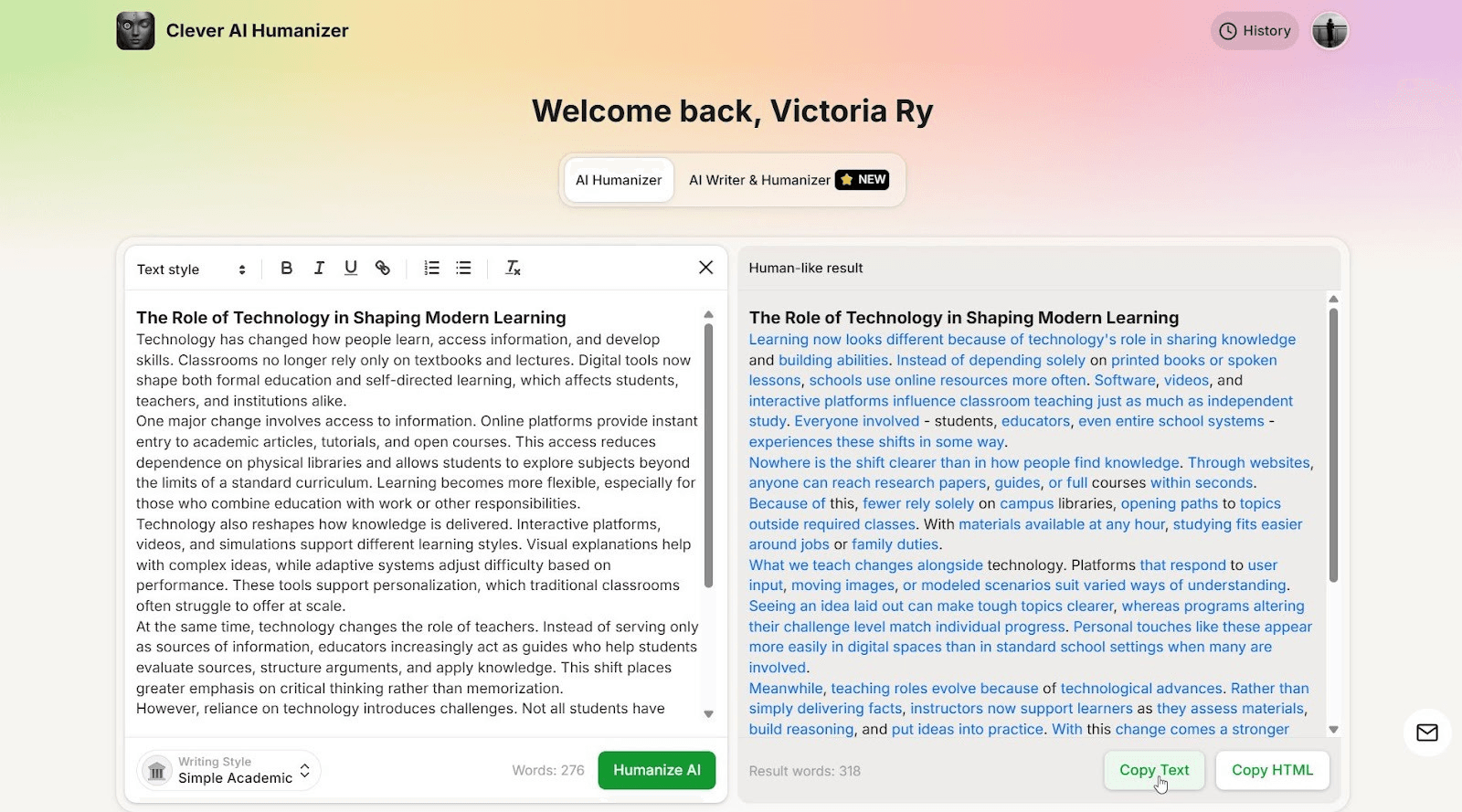
Clever AI Humanizer is one of the best free AI essay humanizers available right now. It offers a generous word limit per month (200,000 words) and handles long-form text in a single run (up to 7,000), which sets it apart from many alternatives that restrict input to short samples.
Key features include a History panel that lets you revisit and reuse past humanization runs, and an AI Writer that can generate already humanized text. Clever also supports multiple writing styles, from casual to academic.
In our tests, Clever AI Humanizer delivered the most stable results across full academic essays. On average, AI-detection scores dropped from 90–100% AI in original drafts to 0–5% AI across GPTZero and ZeroGPT. Results stayed within this range even on essays above 2,000 words. Grammar quality remained high, with internal checks and external grammar tools placing the output at roughly 9/10 consistency. Sentence rhythm improved without excessive restructuring. Arguments stayed intact, and section transitions required little to no manual repair.
Detector behavior matched readability. When scores dropped, the text also sounded natural to a human reader. Unlike aggressive tools, Clever avoided unnatural synonym chains or distorted academic phrasing. This tool worked best for full essay humanization where structure, clarity, and tone mattered more than extreme rewriting.
Pros
- AI humanizer + AI Writer on one platform
- Up to 7,000 words per run with a monthly limit of 200,000 words
- Lowest average AI-detection scores across long essays
- Stable performance on texts over 1,500 words
- Strong grammar and academic tone
- Minimal manual correction required
- Preserves argument structure and citations
Cons
- Not ideal for users who want dramatic rewrites
2. Phrasly
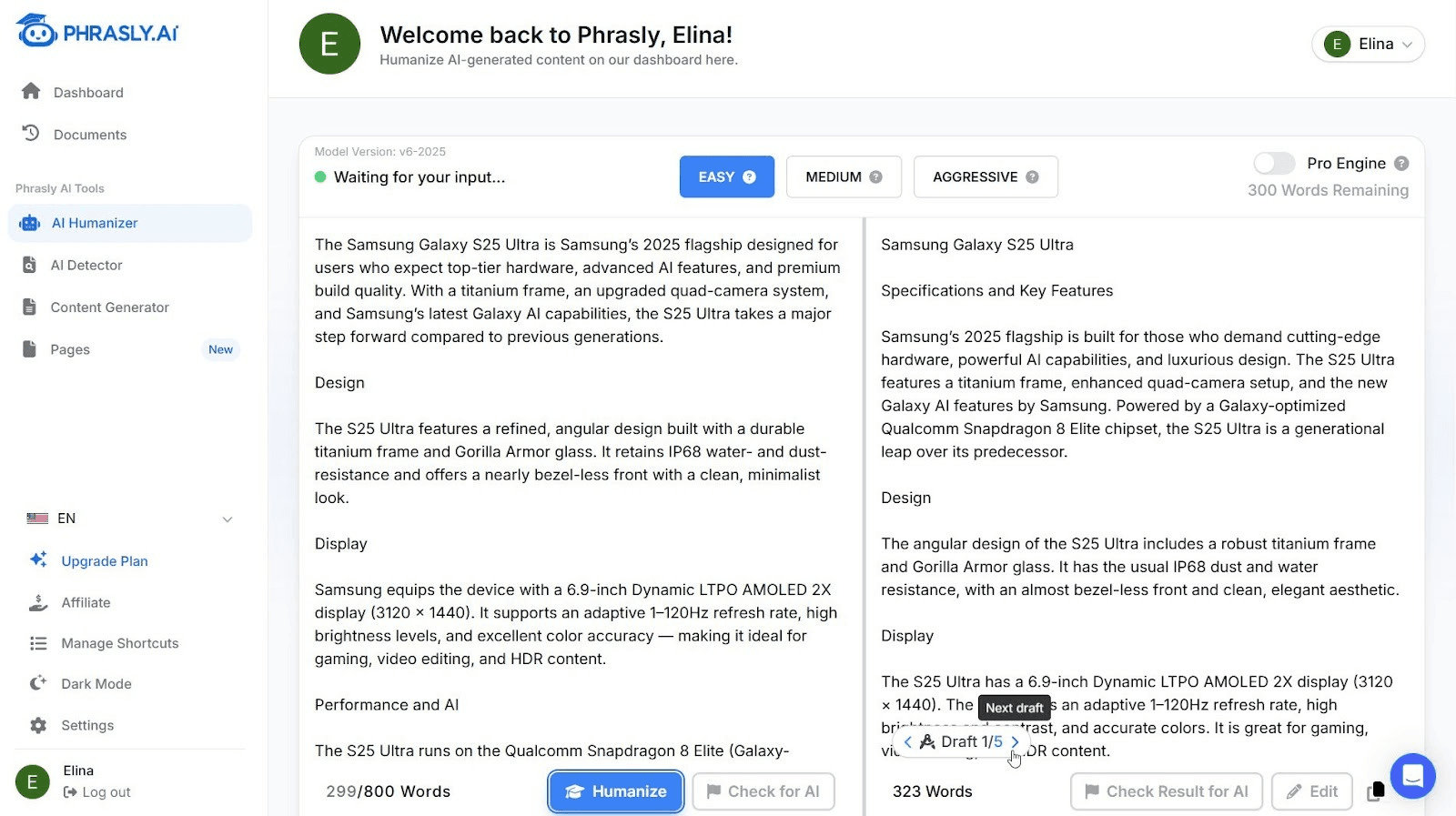
Phrasly is an AI humanizer that focuses on paraphrasing AI-generated text and offers a few related tools in the same dashboard. Alongside the humanizer, it includes a built-in AI detector and basic content utilities. The tool supports three rewrite levels, from light to aggressive, and provides up to five rewrite variants per run, which helps compare outputs quickly.
That said, Phrasly has strict word limits. The free version allows around 550 words, and longer texts require a paid plan. Account registration is mandatory, even for basic use.
As for our testing, Phrasly performed well on short to mid-length academic sections. Detection scores typically dropped from 90–100% AI to 20–35% AI on GPTZero and ZeroGPT when applied to individual paragraphs or sections. Grammar quality stayed strong, around 9–9.5/10, with clear sentence-level improvements. Flow and lexical variation improved most in introductions, conclusions, and isolated body paragraphs.
On longer essays, results varied. Early sections often showed reduced AI signals, while later parts retained detectable patterns. Detection scores fluctuated within the same document, which reflected visible tone shifts during manual review. Phrasly worked best as a selective editing tool, not a one-pass solution for full academic papers.
Pros
- Strong sentence-level rewriting quality
- High grammar consistency in short texts
- Multiple rewrite variants per run
- Adjustable rewrite strength
- Works well for introductions, conclusions, and problem paragraphs
Cons
- Inconsistent detection scores on long essays
- Tone drift across multi-section papers
- Requires manual coherence checks
3. BypassGPT
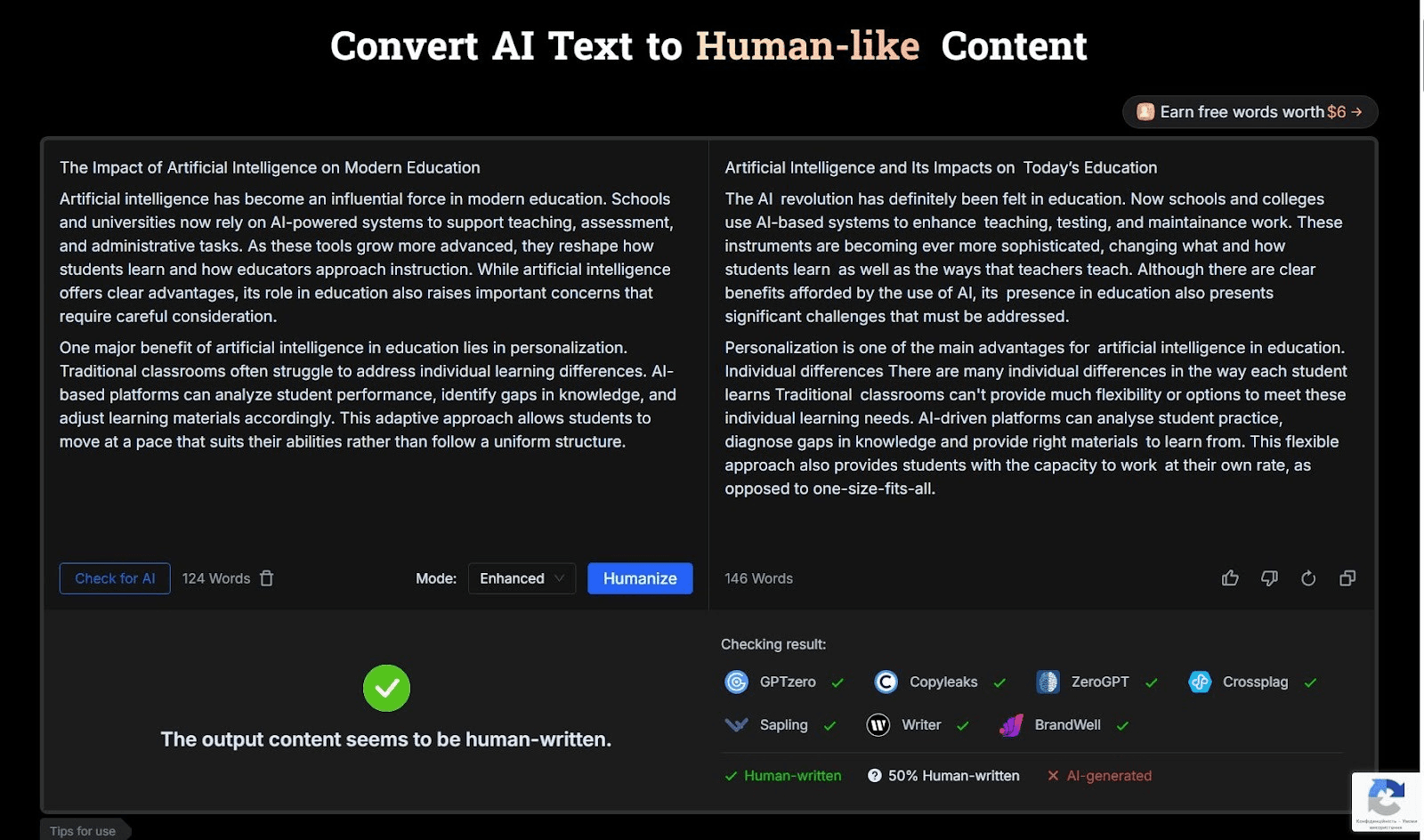
BypassGPT is an AI academic humanizer designed with a clear priority: rapid and aggressive reduction of AI-detectable patterns. The tool focuses almost entirely on rewriting sentence structure to pass popular AI detectors rather than on stylistic refinement or academic polish. One feature we like is that it automatically checks the output against popular AI detectors. However, the tool has strict word limits, only 125 words for free before you need to move on to a paid plan.
BypassGPT focused on aggressive pattern alteration. In many cases, AI-detection scores dropped sharply, often from 90–100% AI to 10–25% AI, especially on stricter detectors. However, this reduction often came at a cost. Grammar quality averaged 7.5–8.5/10, and some sentences lost precision. Academic phrasing sometimes felt overworked, which required manual cleanup.
Detector scores improved faster than readability. In several essays, sections with low AI scores still needed revision to restore clarity, citation alignment, or logical flow. BypassGPT made sense when detection sensitivity mattered more than polish, but it worked best when combined with manual editing.
Pros
- Strong reduction of AI-detectable patterns
- Performs well against stricter detectors
- Very fast rewrite speed
- Simple interface with no setup friction
- Supports multiple languages
Cons
- Lower grammar and readability consistency
- Academic tone can feel overworked
- Limited control over rewrite style or strength
- Short limits on the free tier
How to Humanize Academic Writing
Now let’s talk about things you need to pay attention to when you need to humanize an essay. From our experience, most issues come from small things that add up, like structure, tone, or citation handling. Tools help, but they work best when the text already makes sense and follows the assignment rules.
Here is how to humanize AI essay to keep academic writing clear and natural without overworking it:
- Define the purpose of every paragraph and align it with the required essay structure. Academic essays usually follow a specific structure, such as argumentative, analytical, or comparative, and each paragraph must fit that framework. Check that every paragraph serves a clear role within the expected structure, not just the topic in general. Assignment instructions often outline required sections, so we recommend checking it first.
- Lock citations before humanizing, or remove them temporarily if locking is not supported. Academic essays often require precise citation formats and exact source attribution. When a humanizer supports citation locking, use it to protect in-text citations, quotations, and reference lists from changes. If locking is not available, remove citations before humanizing and add them back afterward. Before submission, double-check the final text against the required academic standard. Common formats include APA, MLA, Chicago, Harvard, and IEEE, each of which has strict rules for in-text citations, reference lists, and quotation handling.
- Humanize the essay in sections, not in one pass. Long essays often lose tone and coherence when processed all at once. Break the text into logical sections such as introduction, body segments, and conclusion. This keeps the voice stable and reduces meaning drift.
- Avoid aggressive rewrite settings on academic texts. Strong rewriting often changes terminology or weakens arguments. Academic writing needs precision more than novelty. Use moderate settings to improve flow without altering meaning.
- Compare the original and humanized versions side by side. This makes meaning shifts easier to spot. Focus on claims, definitions, and conclusions. Restore any sentence where the original intent becomes less precise.
- Read the final text aloud once. Awkward phrasing and mechanical rhythm stand out immediately when read aloud. This quick check often catches issues tools miss.
At the end of the day, humanizing an essay is about control. Keep the structure clear, protect citations, and avoid pushing tools too far. When edits stay intentional, the text reads smoother and more confident. That is usually all it takes for academic writing to sound human.
Key Takeaways
After reviewing how different tools handle academic rewriting, several clear conclusions emerge:
- Clever AI Humanizer is a free AI essay humanizer that delivered the most reliable overall performance in our tests. It handled long essays with a stable tone and structure and is a world leader in bypassing the GPTzero detector, especially on full-length academic texts.
- Phrasly works best for selective edits. It improves sentence flow and grammar in short sections but struggles with consistency across multi-section essays.
- BypassGPT prioritizes detection reduction over polish. It can lower AI scores quickly, even on stricter detectors, but usually requires manual cleanup to restore academic clarity.
- Long essays require a controlled workflow. Section-by-section humanization, moderate rewrite strength, and manual review produce far better outcomes than aggressive one-pass rewrites.
- Citation handling remains important. Lock citations when possible or remove them temporarily before humanizing, then verify formatting against required standards.
FAQ
Are humanized AI essays acceptable in academia?
In most academic settings, acceptance depends less on the tool and more on how the text was used. Universities usually care about authorship and originality, not the technical method behind rewriting. From our experience, problems appear when students submit AI-generated content without review. When AI text supports drafting or language polishing, and the student remains responsible for ideas and arguments, issues are far less common. This is why we always advise using humanizers as editing tools.
Can humanizers change citations or references?
Yes, and this is one of the biggest risks. Many humanizers rewrite sentences without fully respecting citation structure, which can break in-text references or alter quoted material. We often see formatting drift, reordered references, or subtle changes in wording that no longer match the cited source. For this reason, our standard approach is simple: humanize the body text first, then review citations manually.
Which tool is the best AI humanizer for long essays?
For long essays, consistency matters more than raw bypass strength. From our testing, Clever AI Humanizer handles multi-section texts with fewer tonal breaks and less semantic drift. Other tools work well on short passages but lose coherence as length increases. Our usual approach splits long essays into sections and processes them carefully. This keeps the argument stable and readable.
Can AI humanizers affect plagiarism checks like Turnitin?
They can, but not always in a predictable way. Humanizers typically reduce similarity scores because they alter phrasing, but they do not replace proper citation or source attribution. We have seen cases where rewritten text passes plagiarism checks yet raises academic integrity concerns for other reasons. Our team treats plagiarism tools and AI detectors as separate systems with different logic. Passing one does not guarantee acceptance by the other, which is why manual review is still important.


