


resources
The Complete List: 50 States with Capitals in Alphabetical Order
15 Feb 2026

Have you ever found yourself needing to recall a state capital, only to draw a blank? Or perhaps you're simply intrigued by the intricate relationship between the U.S. states and their respective seats of government. If so, you've certainly arrived at the right destination. We’ve meticulously compiled a comprehensive, yet easy-to-navigate, list of all 50 states with their capitals, presented in clear alphabetical order. This serves as an invaluable resource for anyone keen to deepen their understanding of U.S. geography, whether it's for an academic assignment, a competitive trivia night, or simply for personal enrichment. We've aimed for clarity and precision—just the essential facts, presented without unnecessary complexities.
Key Takeaways
- This curated list showcases all 50 U.S. states and their corresponding capital cities.
- For ease of reference, both states and capitals are organized alphabetically by state name.
- It functions as an accessible, straightforward reference tool for enhancing U.S. geography knowledge.
- Grasping the location of state capitals is beneficial for both educational pursuits and general civic literacy.
- The list is thoughtfully structured to facilitate effortless reading and rapid information retrieval.
1. Alabama (Montgomery)
Alabama, a state celebrated for its profound history and varied landscapes, designates Montgomery as its capital city. This vibrant city holds an indisputable and significant position in American history, particularly notable for its role during the Civil Rights Movement.
Montgomery's ascension to capital status was hardly linear, however. It was formally established as the capital in 1846, succeeding Tuscaloosa. Prior to this, Alabama had experimented with several other temporary capitals as the burgeoning state developed its administrative infrastructure.
Montgomery's role as a focal point for the Civil Rights Movement is undeniable. It was the site of the Montgomery Bus Boycott, a pivotal event that helped spark broader change across the nation.
Here are a few essential facts regarding Montgomery:
- Established as Capital: 1846
- Historical Significance: A key location during the Civil Rights Movement and notably served as the first capital of the Confederate States of America in 1861.
- Location: Situated centrally within Alabama, gracing the banks of the Alabama River.
Montgomery consistently remains a crucial hub for both government and culture within Alabama, attracting visitors eager to explore its substantial historical contributions.
2. Alaska (Juneau)
Journeying northward, we arrive in Alaska, a state renowned for its expansive wilderness and breathtaking natural splendor. Its capital city is Juneau. Nestled dramatically in the Alaska Panhandle, Juneau possesses a distinctive characteristic: it's solely accessible by boat or plane. Indeed, no roads connect it to the broader state or the contiguous United States.
Juneau assumed its role as capital in 1906, taking over from Sitka. Historically, the area was known as Novo-Arkhangelsk, the capital of Russian America. The strategic decision to relocate the capital aimed to bring governmental functions closer to the emerging population centers of the time.
Let's consider a few key points about Juneau:
- It stands as the second-largest city in the U.S. by area, encompassing a staggering 3,200 square miles.
- Despite its immense geographical footprint, it's remarkably not reachable by car.
- The city is spectacularly surrounded by towering mountains and majestic glaciers, crafting a truly dramatic landscape.
The selection of Juneau as the capital was influenced by its growing importance as a center for government and commerce in the region. This move reflected the changing demographics and economic activities in Alaska at the turn of the 20th century.
3. Arizona (Phoenix)
Arizona, famously known as the Grand Canyon State, proudly holds its capital in Phoenix. This vibrant metropolis wasn't always the nucleus of Arizona's government, however. It officially secured its status as the capital in 1889, succeeding Prescott. Phoenix is, by any measure, a sprawling and significant urban area; it's not merely the capital but also Arizona's most populous city.
Phoenix boasts a long and layered history as a governmental seat. Before Arizona achieved statehood, it served as the capital of the U.S. Territory of Arizona, beginning in 1889. It's quite intriguing to observe how capital cities can transition over time as territories expand and eventually mature into states.
Here's a concise overview of Phoenix:
- Established as Capital: 1889
- Area: Approximately 517.6 square miles
- Population (2020 Census): Exceeding 1.6 million people
- Significance: It stands as the most populous city in Arizona and functions as the state's governmental nerve center.
The journey to Phoenix becoming the capital involved a few other locations. Prescott held the title before Phoenix, and even earlier, places like Fort Whipple and Tucson were significant administrative centers during the territorial period. This demonstrates how the center of government can shift as a region develops.
Phoenix is widely recognized for its arid desert climate and serves as a major nexus for culture, economy, and transportation throughout the American Southwest. It’s a dynamic city that fundamentally shapes the state's identity.
4. Arkansas (Little Rock)
Arkansas, admitted to the Union in 1836, has Little Rock as its capital city. This vibrant urban center is strategically positioned on the Arkansas River, a location that has profoundly influenced its historical trajectory and ongoing development.
Little Rock wasn't always the capital, though. The state's early history witnessed a few different locations serving as the seat of government. Arkansas Post, for example, held the distinction of being the first capital when the region was organized as a territory in 1819. Subsequently, the capital transitioned to Little Rock in 1821, where it has remained steadfast ever since, solidifying its place as the state's paramount political and cultural core.
Interestingly, the pronunciation of "Arkansas" itself has a unique backstory, with the state legislature officially mandating a specific pronunciation in 1881 to prevent any ambiguity.
Here's a brief compilation of key facts about Little Rock:
- Established: 1821
- Significance: Serves as the state capital and is a major economic and cultural hub.
- Location: Gracefully situated on the Arkansas River, near the geographic center of the state.
The city's name, Little Rock, derives from a distinctive rock formation on the bank of the Arkansas River, first noted by French explorers in the early 18th century. It was christened 'La Petite Roche' or 'Little Rock' to differentiate it from a larger upstream formation.
5. California (Sacramento)
California, often lovingly referred to as the Golden State, designates Sacramento as its capital. This historically significant city is nestled within Sacramento County, right in the fertile heart of the Central Valley.
Sacramento formally became California's official capital in 1854. Prior to this, the capital had a rather itinerant existence, shifting locations quite frequently during the state's formative, often tumultuous, years. Consider the journey: from Monterey to San Jose, and then finally settling in Sacramento. It's a city steeped in rich history, intrinsically linked to the transformative Gold Rush era and the broader development of the American West.
Here's a concise overview of some facts about Sacramento:
- Founded: 1848
- Became State Capital: 1854
- County: Sacramento County
- Nickname: The City of Trees
Sacramento is far more than just a political center; it's a dynamic hub for culture and innovation. It's widely celebrated for its tree-lined thoroughfares and its strategic role as a gateway to Northern California's breathtaking natural beauty. Moreover, the city plays a substantial part in the state's agricultural economy, a natural consequence of its location within such a fertile region.
The journey to establishing Sacramento as the permanent capital wasn't a straight line. It involved a series of decisions and shifts, reflecting the rapid growth and changing needs of California after it joined the Union. This constant movement highlights the dynamic nature of the state's formative years.
6. Colorado (Denver)
Colorado, affectionately known as the Centennial State, proudly claims Denver as its capital. Denver has maintained this esteemed position since 1867, a year before Colorado officially achieved statehood. It's a city that has witnessed remarkable transformations over the decades, evolving from a modest settlement into a major metropolitan nexus.
Before Denver secured its status as the permanent capital, a few other locales served as temporary seats of government for the Colorado Territory. These included places like Denver City (as it was then known), Golden City, and Colorado City. It's rather intriguing to observe how the capital's location shifted somewhat before finally settling on Denver.
Here's a quick glimpse at Denver's governmental timeline:
- Became territorial capital: 1861
- Became state capital: 1876
- Current status: Capital and most populous city of Colorado
Denver's path to becoming the capital is intrinsically linked to the broader development of the American West. As more pioneers and settlers moved into the region, particularly spurred by the discovery of gold, the imperative for a stable governmental center became undeniably clear. Denver, strategically situated at the confluence of the South Platte River and Cherry Creek, served as a natural crossroads and consequently experienced rapid growth.
The city's location played a big role in its selection as a capital. Being a central point for transportation and commerce made it a logical choice for governing the growing territory and later the state.
7. Connecticut (Hartford)
Connecticut, a state celebrated for its rich historical tapestry and quintessential New England charm, designates Hartford as its capital city. Gracefully positioned along the Connecticut River, Hartford has sustained its significance as a vital hub for centuries.
Hartford's trajectory to becoming the singular capital is, in fact, quite fascinating. It didn't always hold the exclusive title as the seat of government. For a considerable period, Connecticut operated with "joint capitals," a unique arrangement where both Hartford and New Haven shared administrative responsibilities. The General Assembly, for instance, would convene its May session in Hartford and its October session in New Haven. This collaborative governance approach persisted for a significant duration, reflecting a spirit of shared authority.
Here's a concise overview of the timeline:
- 1639: Hartford was established as the capital of the English Colony of Connecticut.
- 1689: Following a brief interlude where Boston served as the capital of the Dominion of New England, Hartford was re-established as the capital of the English Colony of Connecticut.
- 1701-1776: Hartford and New Haven jointly served as capitals.
- 1875: Hartford was definitively designated as the sole capital of the State of Connecticut.
Today, Hartford is not just the political center but also a vibrant city with a strong presence in insurance, education, and culture. Its historical significance is evident in its architecture and the many stories it holds.
8. Delaware (Dover)
Delaware, holding the esteemed distinction as the first state to ratify the U.S. Constitution, boasts a capital city whose history stretches back well into the colonial era. That city, of course, is Dover.
Before achieving its current status as the capital of the First State, Dover served as a significant administrative center for the broader region. Its journey to becoming the permanent capital involved several other locations that, at various times, held that prestigious title. Early on, Swedish and Dutch settlements each established their own centers of power. Fort Christina, for example, was the capital of the Swedish colony of Nya Sverige in 1638. Later, Dutch influence brought New Amsterdam (present-day New York) into play as a capital for the province of Nieuw-Nederland.
When English control was firmly established, New Castle became the capital of the English Lower Counties on the Delaware in 1704. It wasn't until 1777, in the wake of Delaware's declaration of independence, that Dover was officially selected as the state capital. This pivotal decision irrevocably cemented its role as the seat of government for the nascent state.
Here's a brief look at some of the historical capitals in the Delaware region:
- Fort Christina (1638): Served as the capital of the Swedish colony.
- New Amsterdam (1655): Functioned as the capital under Dutch rule.
- New Castle (1704): Designated as the capital of the English Lower Counties.
- Dover (1777): Became the permanent capital of Delaware.
Dover's selection as the capital was influenced by its central location within the state, making it more accessible for representatives from different parts of Delaware. This strategic positioning has helped it maintain its status throughout the centuries.
9. Florida (Tallahassee)
Florida, a state celebrated for its abundant sunshine and beautiful beaches, possesses a capital city that deeply reflects its extensive history: Tallahassee.
Tallahassee was designated the capital of the Florida Territory in 1824, just 21 years before Florida officially achieved U.S. statehood in 1845. Prior to Tallahassee's prominence, the region saw various settlements and administrative centers rise and fall. St. Augustine, for instance, functioned as a capital for both Spanish and British Florida for an extended period, commencing as early as 1565. Pensacola also had its turn as a capital during the colonial era.
By the time Florida attained statehood in 1845, Tallahassee was already firmly established as its political heart. The city's location was judiciously chosen because it was roughly equidistant between the primary population centers of St. Augustine and Pensacola at the time. This made it a more central and thus more accessible choice for governing the expanding territory and, subsequently, the newly formed state.
Here's a quick overview of Florida's progression to its present capital:
- Colonial Era: St. Augustine (1565-1820s) served as a primary administrative center for Spanish and British Florida.
- Territorial Period: Tallahassee was selected as the capital of the Florida Territory in 1824.
- Statehood: Tallahassee officially became the capital of the State of Florida in 1845.
The selection of Tallahassee as the capital was a strategic decision, aiming for a central location within the vast territory. This ensured that governance could reach different parts of Florida more effectively.
Today, Tallahassee is not merely the seat of government but also a vibrant city benefiting from a significant university presence, which contributes to its dynamic atmosphere. It continues to be the crucial locus where Florida's laws are crafted and its future directions are determined.
10. Georgia (Atlanta)
Georgia, a state steeped in a rich and complex history, proudly claims Atlanta as its capital. This bustling metropolis, however, wasn't always the central nexus of Georgia's government.
Before Atlanta took center stage, several other locations admirably served as the state's capital. Savannah, for example, was a significant early capital, fulfilling that role for the British proprietary Colony of Georgia and later the British Province of Georgia. Augusta also held the distinction of being the capital multiple times, particularly during periods of profound political and social change and conflict.
Here's a brief look at some of Georgia's historical capitals:
- Savannah
- Augusta
- Louisville
- Milledgeville
Atlanta formally became the capital in 1868. Since then, it has blossomed into a major hub for business, culture, and transportation throughout the Southeast. The city's selection as capital notably marked a new era for Georgia, powerfully symbolizing its post-Civil War resurgence.
Atlanta's journey to becoming the state capital is tied to its strategic location and its role in the state's development. It has since become a major economic and cultural center.
11. Hawaii (Honolulu)
Aloha! Let's turn our attention to Hawaii, the enchanting island state, and its capital, Honolulu. It's a place with a truly captivating past, not just as a U.S. state but as its own sovereign nation. Honolulu, it seems, has been at the heart of affairs for a considerable span of time.
Before it joined the U.S. as a state, Hawaii existed first as a kingdom, then as a republic. During these earlier periods, the capital enjoyed a somewhat migratory existence. Places like Waikīkī, Hilo, Kailua-Kona, and Lahaina all, at various points, served as the seat of government. Yet, Honolulu has remained the principal hub since 1845, a role it embraced even before Hawaii’s annexation by the United States.
When Hawaii was annexed by the U.S. in 1898, Honolulu seamlessly maintained its central role. It continued to serve as the capital of the Territory of Hawaii and has steadfastly done so as the capital of the State of Hawaiʻi since statehood in 1959. It's rather extraordinary to contemplate the depth of history that has unfolded within its bounds.
Here's a concise overview of Honolulu's journey as a capital:
- 1803–1812: Served as the capital of the Kingdom of Hawaii.
- 1845–1898: Became the capital of the Kingdom of Hawaii and subsequently the Republic of Hawaii.
- 1900–1959: Functioned as the Capital of the Territory of Hawaii.
- 1959–Present: Continues as the Capital of the State of Hawaiʻi.
So, when you envision Hawaii, remember that Honolulu is not merely a city of breathtaking beauty; it's a place deeply rooted in history, having long served as a vital center of power and governance for the Hawaiian Islands.
12. Idaho (Boise)
Idaho, a state celebrated for its rugged mountains and abundant outdoor adventures, proudly names Boise as its capital. This dynamic city has served as the seat of government since 1865, positioning it as one of the longer-standing capitals in the Western United States.
Boise's path to capital status wasn't a direct one. When Idaho was organized as a territory in 1863, the capital was initially established in Lewiston. However, a mere two years later, the capital was strategically relocated to Boise—a more central location that was, at the time, experiencing rapid growth.
Here's a brief profile of Boise:
- Established as Capital: 1865
- Statehood: July 3, 1890 (becoming the 43rd state)
- Nickname: The City of Trees
Boise has expanded considerably since its designation as capital. It now stands as the most populous city in Idaho, functioning as a primary hub for business, culture, and government. The city's advantageous location in the southwestern portion of the state, nestled within the picturesque Boise River Valley, has been instrumental in shaping its development and ensuring its accessibility.
The selection of Boise as the territorial capital in 1865 was a strategic move, aiming to consolidate administrative functions in a location that could better serve the expanding population and economic activities across the territory. This decision laid the groundwork for Boise's future as the primary center of Idaho.
13. Illinois (Springfield)
Illinois, frequently dubbed the "Prairie State," proudly holds Springfield as its capital. This city has maintained that distinguished title since 1837, making it the second-longest serving state capital in Illinois's history. Prior to Springfield, the capital enjoyed a somewhat nomadic existence, with Kaskaskia and Vandalia successively serving as the seats of government.
Springfield isn't merely the political epicenter; it's also inextricably linked to Abraham Lincoln. His cherished home, law office, and indeed, his final resting place are all situated here, attracting countless visitors eager to delve into American history. The city itself spans approximately 54 square miles and, according to the 2020 census, hosted a population just exceeding 114,000 people. It forms part of a larger metropolitan area that encompasses several hundred thousand residents.
Here's a concise overview of Springfield's pivotal role:
- Established as Capital: 1837
- Area: Approximately 54.0 square miles (140 km2)
- Population (2020 Census): 114,394
- Historical Significance: Home to Abraham Lincoln's presidential library and museum, his preserved home, and his tomb.
Springfield's selection as the capital was a bit of a compromise, aiming to place the government in a more central location within the growing state. It has since grown into a significant cultural and historical hub.
While not the largest city in Illinois — that honor unequivocally belongs to Chicago — Springfield plays a critical role in the state's administration and historical narrative. It is the very place where state government business unfolds daily, and where the enduring legacy of one of America's most revered presidents is meticulously preserved.
14. Indiana (Indianapolis)
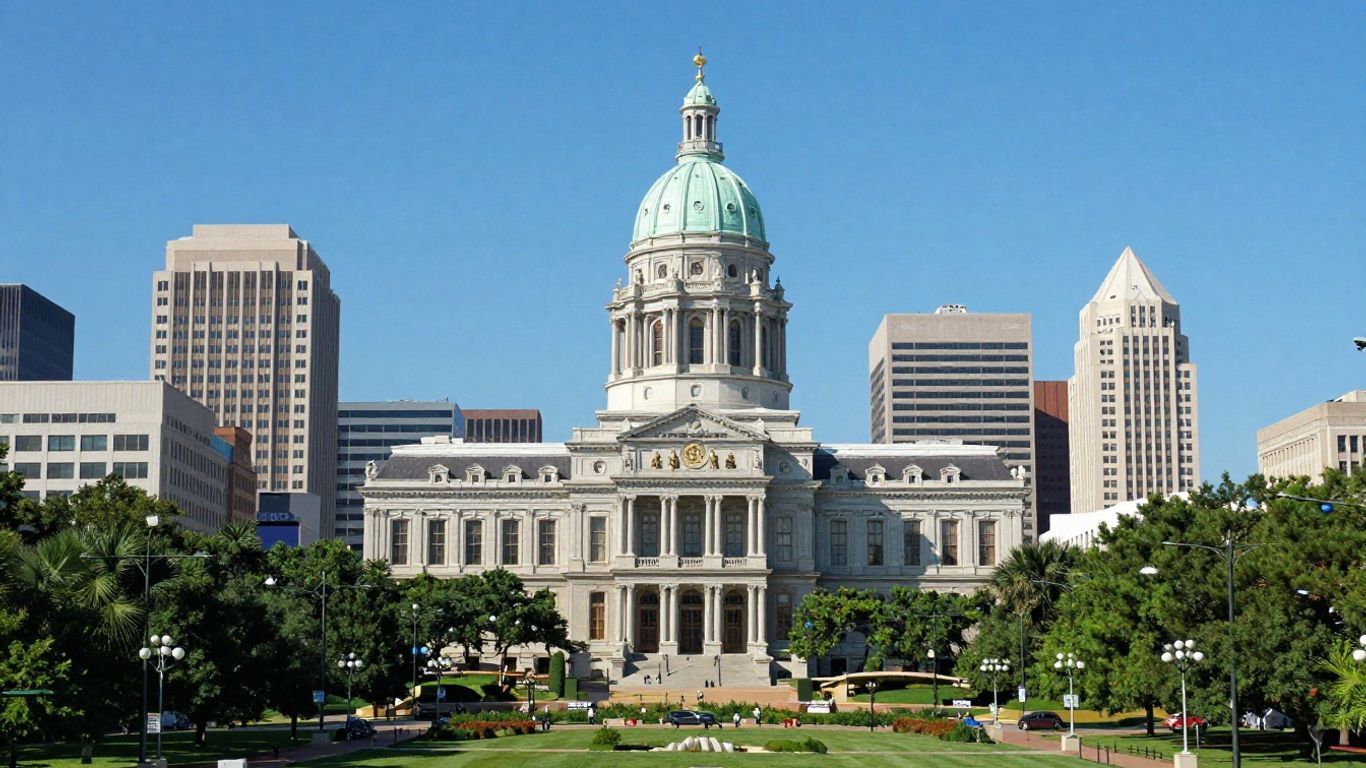
Indianapolis, the capital of Indiana, boasts a rather intriguing history concerning its governmental seat. It wasn't always the uncontested center of Hoosier State power, though. In fact, the state's capital has transitioned a few times before ultimately settling in Indianapolis.
Indiana achieved statehood in 1816. Before Indianapolis was established as the capital, the government's operations were based first in Vincennes and subsequently in Corydon. The strategic decision to move the capital to a more central location within the state led directly to the founding of Indianapolis. This city was uniquely planned from its inception to serve as the state capital, featuring a deliberate grid system and a prominent central monument.
Here's a concise overview of Indiana's capital journey:
- Vincennes: Served as the capital of the Indiana Territory beginning in 1800.
- Corydon: Became the capital when Indiana achieved statehood in 1816.
- Indianapolis: Chosen as the permanent capital in 1820 and officially became the seat of government in 1825.
Indianapolis was specifically chosen as the capital site due to its central location within the state. This strategic positioning made it considerably more accessible for citizens hailing from all corners of Indiana.
The planning of Indianapolis was quite deliberate. A committee selected the site in 1820, and the city was laid out with a diamond-shaped center and radiating avenues, a design intended to be both functional and symbolic of the state's growing importance. It was a fresh start, a city built with the express purpose of governing a state.
Today, Indianapolis functions not only as the political nucleus but also as a major economic and cultural hub for Indiana. It's widely celebrated for its rich racing heritage, particularly the iconic Indianapolis 500, and its dynamic downtown area.
15. Iowa (Des Moines)
Iowa's capital city, Des Moines, has held that distinguished title since 1857. Prior to this, the capital was situated in Iowa City. The relocation to Des Moines represented a significant event in the state's history, powerfully reflecting its sustained growth and development.
Des Moines is strategically positioned in the central part of the state, precisely at the confluence of the Des Moines and Raccoon Rivers. This particular location was selected for its inherent accessibility and central placement, rendering it a highly practical choice for the state's government.
Here are some essential facts about Des Moines:
- Established as Capital: 1857
- Area: Approximately 75.8 square miles (196 km²)
- Population (2020 Census): 214,133
The selection of Des Moines as the capital was part of a larger effort to centralize state functions and provide a more permanent seat of government for the growing state of Iowa. The decision involved legislative debate and ultimately led to the construction of the current State Capitol building, a prominent landmark in the city.
The city has expanded considerably since its designation as the capital. It now serves as a significant hub for the insurance, finance, and technology sectors, and it continues to be the undisputed political and economic center of Iowa. The palpable presence of the state government profoundly shapes the city's identity and daily life.
16. Kansas (Topeka)
Kansas, a state renowned for its expansive plains and vibrant agricultural heartland, proudly claims Topeka as its capital. This city has held the title of capital since Kansas achieved statehood in 1861, though its journey to becoming the permanent seat of government was, in fact, somewhat more intricate.
Before Topeka was officially designated the capital, the Kansas Territory saw a few different locations serve as its temporary seat of government. These included places like Pawnee (for a remarkably brief period in 1855), Shawnee Mission, and Lecompton. Lecompton, specifically, was established as the pro-slavery capital during the turbulent and often violent "Bleeding Kansas" era.
However, the anti-slavery faction firmly established Topeka as their de facto capital. When Kansas was admitted to the Union as a free state in 1861, Topeka consequently received official recognition as its capital. It's a city that profoundly grew from these foundational, often contentious, moments to become the undeniable center of Kansas's government and a vital hub for its rich history.
Here's a concise overview of some facts about Topeka:
- Established: 1855 (as a de facto territorial capital)
- Became State Capital: 1861
- Area: Approximately 56.0 square miles (145 km²)
- Population (2020 Census): Around 126,587
The selection of a permanent capital often reflects the political and social currents of the time, and Topeka's story is tied to the state's struggle for statehood and its identity as a free state.
17. Kentucky (Frankfort)
Gracefully nestled along the verdant banks of the Kentucky River, Frankfort proudly serves as the capital of the Commonwealth of Kentucky. It's a city with a distinguished history that stretches back to the waning years of the 18th century.
Frankfort formally assumed its role as capital in 1792, coincidentally the very same year Kentucky achieved statehood. Prior to this, the government had convened briefly in Lexington. The selection of Frankfort was a deliberate and strategic one, aimed at securing a central location within the rapidly expanding state. It's noteworthy that during the tumultuous period of the Civil War, Bowling Green briefly functioned as a rival Confederate state capital.
Here's a concise overview of some key details about Frankfort:
- Established as Capital: 1792
- Location: Franklin County
- Significance: The undisputed seat of the Kentucky state government, encompassing the General Assembly and the Governor's office.
The city's development was influenced by its role as a governmental center, attracting people and businesses involved in state affairs. Its strategic location on the river also played a part in its early growth and importance.
Today, Frankfort is not merely a political hub but also a place possessing a distinct character, celebrated for its historic architecture and its profound connection to Kentucky's rich and enduring heritage.
18. Louisiana (Baton Rouge)
Louisiana, a state celebrated for its rich tapestry of history and vibrant culture, proudly designates Baton Rouge as its capital. This city is strategically positioned on the eastern bank of the mighty Mississippi River, a location that has played a profoundly significant role throughout its entire existence. However, the journey to Baton Rouge becoming the permanent capital was hardly a straight path.
Before firmly settling on Baton Rouge, Louisiana's capital status experienced a few distinct shifts. New Orleans, a major port city and cultural icon, served as the capital for extended periods, especially during the early formative years. Yet, during the tumultuous Civil War, the capital was compelled to relocate. It temporarily moved to Opelousas and then to Shreveport for a time, before eventually returning to Baton Rouge.
Here's a concise overview of some of Louisiana's capital history:
- New Orleans: Served as the capital multiple times, including when Louisiana achieved statehood in 1812.
- Donaldsonville: Experienced a brief tenure as the capital in 1830.
- Baton Rouge: First became the capital in 1849, then again in 1882, and has steadfastly remained so ever since.
Baton Rouge's selection as the capital in 1849 marked a significant shift, deliberately moving the seat of government away from the bustling, often chaotic, port of New Orleans. The city's strategic location and its more central position within the state likely contributed substantially to this pivotal decision. Today, Baton Rouge functions not only as the political center but also as a crucial hub for industry and education across Louisiana.
19. Maine (Augusta)
Maine, affectionately known as the "Pine Tree State," formally adopted Augusta as its capital in 1832. Before Augusta assumed this crucial role, Portland served as the state's capital for a brief period beginning in 1820. The path to establishing a permanent capital involved a few distinct shifts, reflecting the early developmental stages of the state.
Maine's history with a dedicated capital city is relatively shorter when compared to some of its more established neighbors. Portland held the distinction of being the first capital after Maine achieved statehood in 1820. However, the legislature soon made the decision to relocate the capital inland, and Augusta was ultimately chosen. This move was finalized in 1832, and Augusta has steadfastly remained the capital ever since.
Here's a concise overview of some key facts about Augusta:
- Established as Capital: 1832
- Area: Approximately 55.4 square miles (143 km²)
- Population: Around 18,899 residents (as of recent estimates)
The decision to move the capital inland to Augusta was influenced by a desire for a more central location and perhaps a bit of a fresh start for the new state. It wasn't a dramatic shift, but it marked a significant step in solidifying Maine's identity as it grew.
20. Maryland (Annapolis)
Maryland, a state steeped in profound history, proudly claims Annapolis as its capital. This charming city has served as the state capital since 1694, though it wasn't always known by its present appellation. It was initially christened Anne Arundel's Towne before being officially renamed Annapolis.
Annapolis holds a particularly special place in American history, extending beyond its role as merely Maryland's capital. It briefly functioned as the capital of the United States itself from 1783 to 1784. During this momentous period, the Continental Congress convened here, and it was famously in Annapolis that General George Washington tendered his resignation from military command.
Here are a few essential points about Annapolis:
- Established as a colonial capital: It became the capital of the English Province of Maryland in 1694.
- Brief U.S. Capital: Hosted the Continental Congress from 1783 to 1784.
- Naval Academy Home: Annapolis is also the proud home of the United States Naval Academy, an institution founded in 1845.
The transition from Anne Arundel's Towne to Annapolis marked a significant step in the city's development, solidifying its role as a center of governance and commerce in the region.
21. Massachusetts (Boston)
Boston, the vibrant capital of Massachusetts, boasts a long and truly storied history. It was initially settled in 1630 by English colonists and rapidly evolved into a pivotal center of trade and culture.
Boston has steadfastly served as the capital of Massachusetts for the vast majority of its history.
Here's a concise overview of some key facts about Boston:
- Founded: 1630
- Area: 89.6 square miles (232 km²)
- Population (City): Approximately 675,647
- Population (Metropolitan Area): Exceeding 8.4 million
Over the centuries, Boston has been a focal point for numerous significant historical events, including—most notably—the American Revolution. Its enduring role as a capital city has gracefully evolved alongside the development of both the state and the nascent nation itself.
The city's strategic location on the Atlantic coast made it a vital port and a hub for commerce from its earliest days. This geographical advantage has played a role in its continuous development and importance.
22. Michigan (Lansing)
Michigan's capital city is Lansing. It's geographically situated in Ingham County, right in the central portion of the Lower Peninsula. Lansing ascended to capital status in 1847, succeeding Detroit. This relocation was a pivotal decision, driven by the state's desire for a more centrally located seat of government.
When Michigan achieved statehood in 1837, Detroit held the distinction of being the capital. However, the state constitution explicitly called for a new capital to be established closer to the geographical center of the state. After considerable debate and thorough surveying, a suitable spot near the Grand River was ultimately selected. The burgeoning town was subsequently christened Lansing.
Here's a concise overview of some facts about Lansing:
- Established: 1847
- County: Ingham
- Area: Approximately 35.0 square miles
- Population (2020 Census): Around 112,644
Lansing is also the proud home of the Michigan State Capitol building, a magnificent piece of architecture that has served as the nerve center of state government for over a century. It is here that laws are meticulously crafted and vital decisions are thoughtfully deliberated.
The selection of Lansing as the capital was a strategic decision to ensure accessibility for all regions of the growing state. It marked a new chapter in Michigan's development, moving the center of political power inland.
23. Minnesota (Saint Paul)
Minnesota's capital, Saint Paul, boasts a history that reaches back to its territorial days. It was formally designated as the capital of the Territory of Minnesota in 1849. When Minnesota subsequently achieved statehood in 1858, Saint Paul seamlessly continued its crucial role as the seat of government.
Saint Paul is one of the celebrated "Twin Cities," alongside its larger counterpart, Minneapolis, and together they form a major metropolitan area in the Upper Midwest. The city itself spans approximately 52.8 square miles and is gracefully situated on the iconic Mississippi River.
Here are a few interesting facts about Saint Paul:
- It holds the distinction of being the second most populous city in Minnesota, just after Minneapolis.
- The city is widely recognized for its extensive network of skyways, which conveniently connect numerous downtown buildings.
- Saint Paul is proudly home to both the Science Museum of Minnesota and the Minnesota Children's Museum.
The journey to Saint Paul becoming the permanent capital involved a bit of back-and-forth, but its strategic location on the Mississippi River ultimately secured its position as the state's governmental center.
24. Mississippi (Jackson)
Jackson, Mississippi, has served as the state capital since 1821, though it officially became the permanent capital in 1864. The city is aptly named after Andrew Jackson, a celebrated military hero who later became the seventh U.S. President. Jackson is strategically situated on the Pearl River, a waterway that has historically played a significant role in its development and transportation networks.
Jackson holds the distinction of being the most populous city in Mississippi.
Here's a concise overview of some key figures for Jackson:
- Area: 104.9 square miles (272 km²)
- Population (2020 Census): 153,701
- Metro Area Population (2020 Census): 591,978
Before Jackson assumed the role of capital, other locations served as the seat of government for the Mississippi Territory and the early state. Natchez, for instance, was the capital of the Mississippi Territory from 1798 to 1817, and it also briefly functioned as the first state capital immediately after Mississippi achieved statehood. Washington, Mississippi, also had a short tenure as a territorial capital.
The selection of Jackson as the permanent capital was a compromise, aiming to place the government in a more central location within the growing state. The site was chosen by a commission, and the city was laid out and named in honor of General Jackson, who had led American forces to victory at the Battle of New Orleans.
Over the years, Jackson has evolved into a significant cultural and economic hub for Mississippi. It is celebrated for its historical sites, including splendid antebellum homes and museums that eloquently narrate the story of the state's rich past. The city also plays a vital role in the state's infrastructure, serving as a critical transportation nexus.
25. Missouri (Jefferson City) and more
Continuing our alphabetical journey, we now arrive in Missouri, with its capital being Jefferson City. It's a place that has certainly witnessed its share of history, diligently serving as the state capital since 1826. Before Jefferson City assumed the reins, other locations played important roles in the region's complex governance.
Missouri's capital history is quite compelling. While Jefferson City has maintained its status as the seat of government for a considerable duration, the area was under various administrations long before statehood. For example, St. Louis served as a capital for different territories, including the Spanish district of Alta Louisiana and, subsequently, the Missouri Territory. Saint Charles even enjoyed a brief tenure as the state's capital immediately after Missouri was admitted to the Union in 1821.
Here's a concise overview of some of Missouri's past capitals:
- Saint-Louis (St. Louis): Served as a capital for Spanish and French territories, and later the Missouri Territory.
- Saint Charles: Held the distinction of being the first capital of the state of Missouri upon its admission to the Union.
- Jefferson City: Firmly established as the permanent capital in 1826.
The selection of Jefferson City as the permanent capital was a deliberate choice, aiming for a central location within the state to better serve its growing population and administrative needs. It was named in honor of then-President Thomas Jefferson.
It's truly fascinating to observe how capital cities evolve in tandem with the development of a state. Each historical location tells a distinct part of the compelling story of Missouri's journey from a territory to a proud state.
Wrapping Up Our Capital Tour
So there you have it—all 50 U.S. states and their capitals, meticulously lined up in alphabetical order for your convenience. While it might appear to be a straightforward compendium, possessing knowledge of these fundamental facts can prove incredibly useful, whether you're diligently studying for an examination, meticulously planning a cross-country trip, or simply aiming to deepen your understanding of the diverse nation we inhabit. Consider this list your indispensable, go-to reference for a rapid geographical confirmation. It’s always advantageous to have this caliber of information readily accessible, and now, you certainly do. We encourage you to continue exploring and learning about the rich tapestry of the United States!
Frequently Asked Questions
Why is it useful to know all the state capitals?
Knowing the capitals of all the U.S. states is an excellent way to cultivate a deeper understanding of our country. It's quite helpful for academic pursuits, such as geography assessments, and it undeniably enhances your overall general knowledge about the United States. Moreover, the act of testing your recall can be an enjoyable intellectual exercise!
How can I remember all the state capitals?
There are numerous engaging strategies to commit them to memory! You might create flashcards, participate in interactive online games, or even utilize songs specifically designed to teach states and their capitals. Often, devising humorous mnemonics or employing vivid descriptive words for each state and capital can significantly aid in retention.
Are the capitals always the biggest cities in the state?
Not invariably, no! While some capitals do coincide with their state's largest urban centers, many do not. For instance, Sacramento serves as the capital of California, yet Los Angeles is considerably more populous. It's quite intriguing to observe the diverse considerations states employed when selecting their capital cities.
Have states always had the same capital city?
No, a significant number of states have relocated their capital cities over time. Oklahoma, for example, moved its capital in 1910. Furthermore, before achieving statehood, the regions that now constitute the U.S. frequently had different capitals during their respective periods as colonies or territories.
What does a state capital do?
The capital city is the designated location where the principal governmental offices for that particular state are situated. It functions much like the 'headquarters' for the state's administration, serving as the central forum where important decisions are made and legislative acts are formally passed.
Is Washington, D.C. a state capital?
Washington, D.C. is indeed the capital of the United States, but it does not function as a state capital because D.C. itself is not a state—it's a federal district. Each of the 50 distinct states, naturally, possesses its own unique capital city.


