
citiesabc, first_page
Tufts University's First AI Jobs Risk Index Reveals Which U.S. Cities and Careers Face the Biggest Threat
26 Mar 2026

The same tech hubs building artificial intelligence are also the most exposed to its economic disruption and a new national index now maps the risk down to your city and zip code.
A groundbreaking study from Digital Planet at Tufts University's Fletcher School has produced something that earlier AI workforce analyses largely failed to deliver: a precise, city-by-city breakdown of which American workers are most likely to actually lose their jobs to artificial intelligence, not just in theory, but within the next two to five years.
Up to 9.3 Million U.S. Jobs at Risk — With a $757 Billion Wage Impact
The headline numbers from the American AI Jobs Risk Index are hard to ignore. Under a mid-range scenario, approximately 9.3 million U.S. jobs face displacement due to AI adoption. That figure stretches as low as 2.7 million in a slower-adoption scenario, and climbs as high as 19.5 million if AI tools spread quickly across industries.
The wage exposure is equally striking. Jobs at risk carry combined annual salaries estimated between $200 billion and $1.5 trillion, with a mid-range projection of roughly $757 billion in wages — a figure that dwarfs previous estimates of automation's economic reach.
The Cities Most at Risk May Surprise You
One of the index's most counterintuitive findings involves geography. The American metro areas most vulnerable to AI-driven job loss are not struggling post-industrial towns — they are the very innovation hubs driving AI development.
San Jose, California (the heart of Silicon Valley) leads all U.S. metro areas with a projected 9.9% job displacement rate. Other cities facing at least $20 billion in projected annual income losses include:
At the state level, Washington, D.C. ranks first with an 11.3% displacement risk, followed by Massachusetts, Virginia, Maryland, Washington State, and Colorado.
University cities also appear prominently in the top 25 most vulnerable areas, Durham-Chapel Hill, Boulder, Ann Arbor, Ithaca, and Madison all make the list. Researchers call these clusters "Wired Belts": regions where concentrations of technical talent create both competitive advantage and acute economic exposure.
It's Not Factory Workers Being Replaced This Time
The index fundamentally challenges the long-standing assumption that automation primarily threatens low-skill, repetitive, or physical labor. The data tells a sharply different story.
Across the entire U.S. economy, AI displacement vulnerability averages around 6%. But for knowledge-intensive industries, the numbers are far higher:
| Sector | Displacement Risk |
|---|---|
| Information | 18% |
| Finance & Insurance | 16% |
| Professional, Scientific & Technical Services | 16% |
| Physical/Trade Labor | Under 1% |
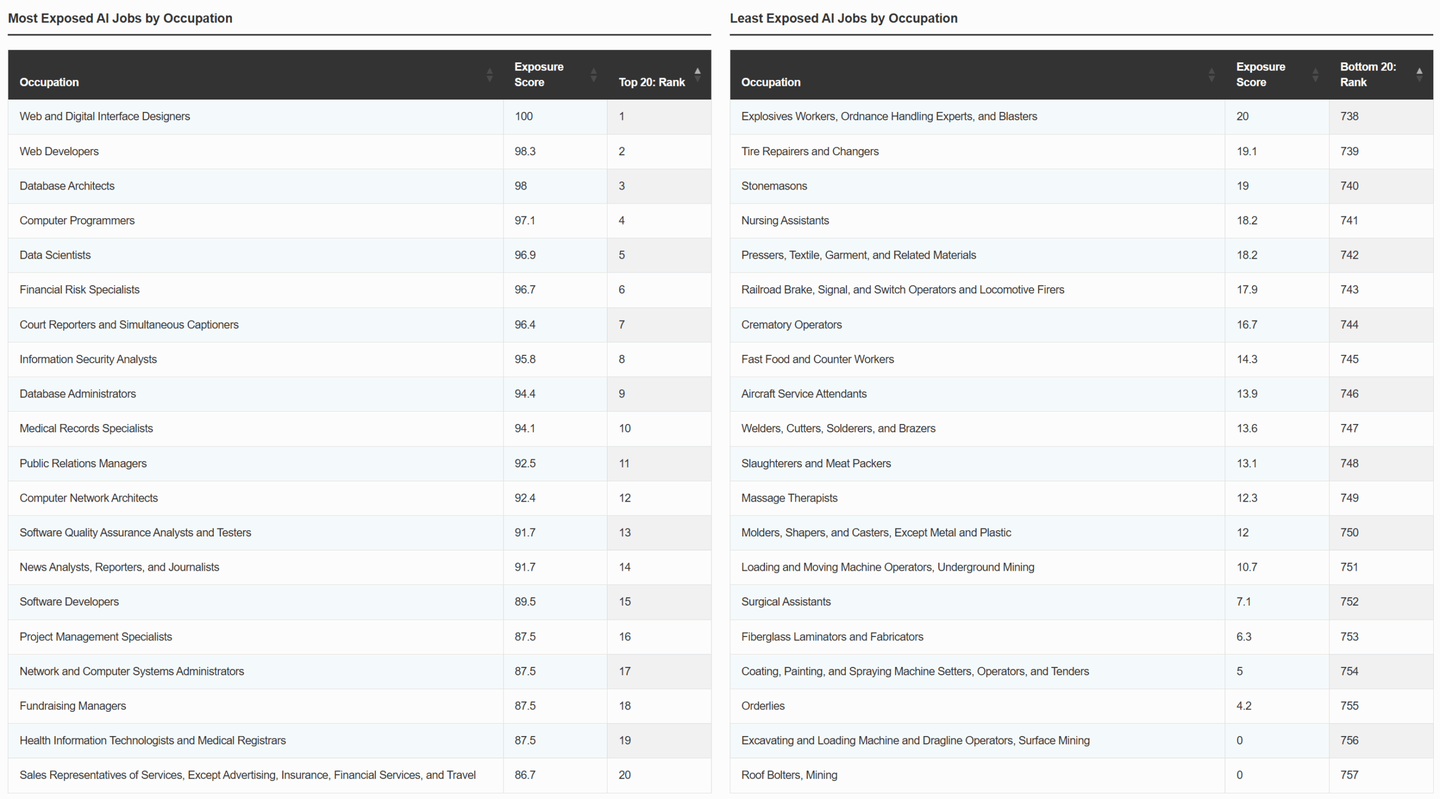
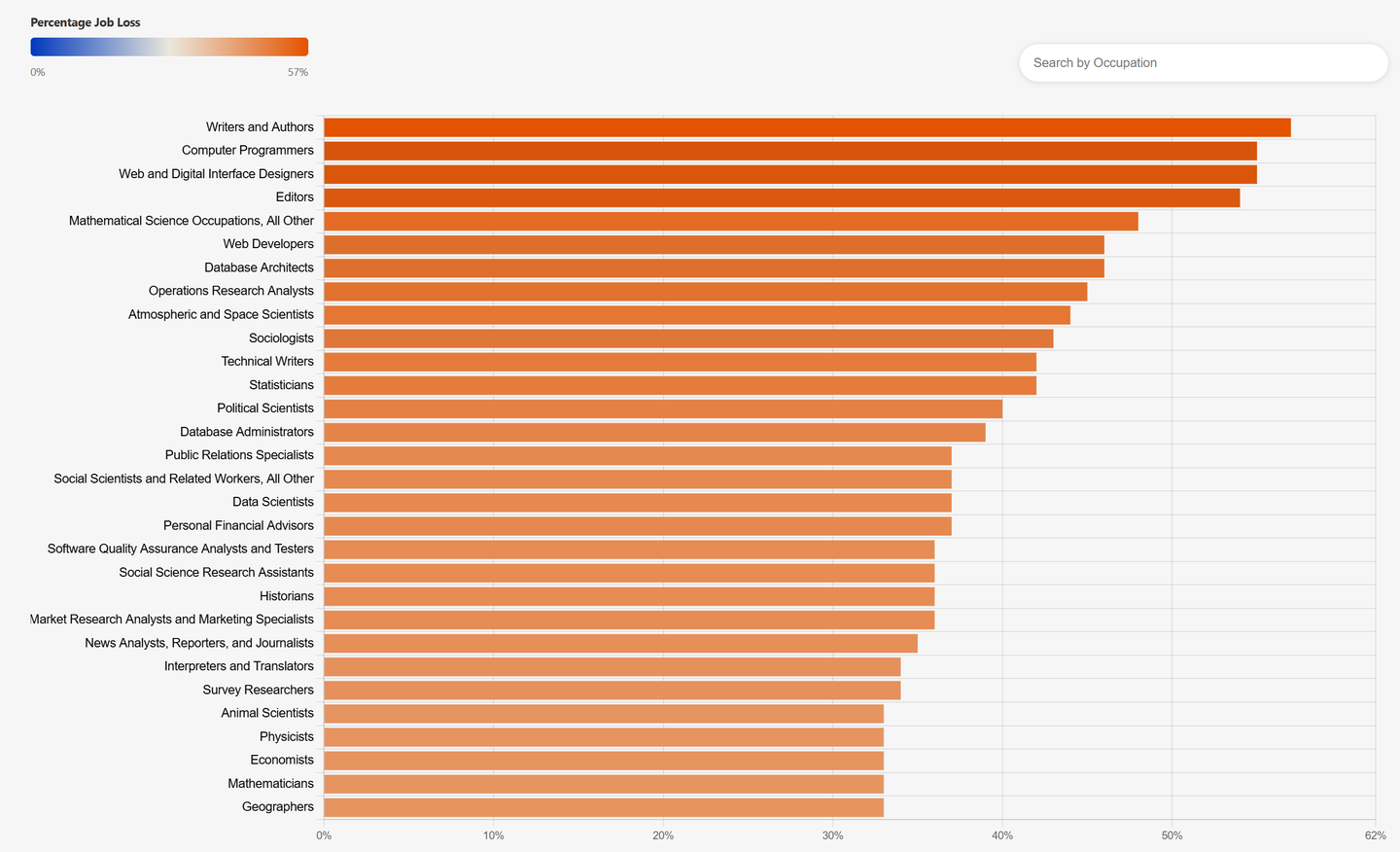
At the occupational level, some of the most exposed roles are among the best-compensated:
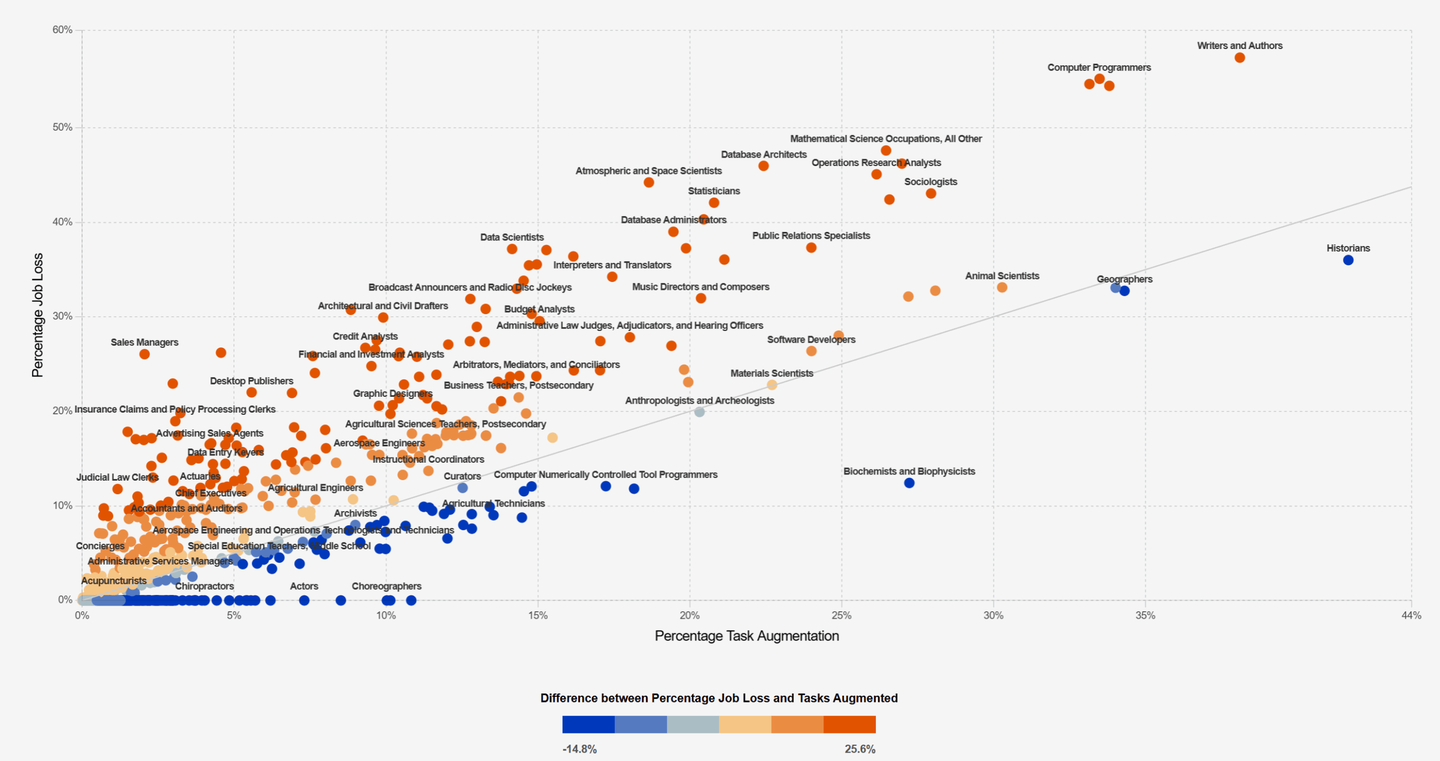
- Historians: 67% of tasks automatable
- Writers and Authors: 57% displacement rate
- Computer Programmers: 55%
- Web Designers: 55%
Meanwhile, roofers, orderlies, and dishwashers face displacement risks below 1%, not because their work is unimportant, but because it is physical, location-dependent, and difficult for current AI systems to replicate.
Bhaskar Chakravorti, dean of global business at The Fletcher School, summarised the shift bluntly:
AI is not just automating routine tasks — it is moving up, targeting the cognitive and analytical work that defines high-skill, high-wage careers.
An unsettling conclusion follows: approximately 38% of American workers face less than 1% displacement risk, and they are mostly lower-wage earners in physical occupations.
"Tipping Point" Jobs: The Next Wave of Risk
Beyond current projections, researchers flagged 33 occupations — covering roughly 4.9 million workers — as "tipping point" roles. In these jobs, displacement risk could leap from under 10% to over 40% depending on how rapidly AI capabilities mature and penetrate industries.
Even workers employed in AI itself are not immune. More than one million people who study, build, or report on artificial intelligence face displacement rates between 26% and 55%.
The report also identifies a striking statistical relationship: for every 1 percentage point increase in automation, the model projects a 0.75 percentage point loss in employment — suggesting that productivity gains from AI may translate fairly directly into workforce reductions rather than expanding output or generating new roles.
A Policy Gap That Could Define the Coming Decade
The geographic concentration of AI job risk is already shaping legislation. States with higher AI exposure are enacting AI-related laws at four times the rate of low-exposure states — a reflection of both economic stakes and institutional capacity.
However, a December 2025 executive order has created friction in that landscape, directing the Justice Department to challenge certain state-level AI regulations and threatening to withhold federal broadband funding from states that pursue independent frameworks. The collision between state and federal approaches to AI governance could significantly affect how cities and workers respond — particularly in the metro areas facing the steepest economic exposure.
What Makes This Index Different
What sets the Tufts index apart from prior studies is methodological. Rather than estimating which jobs AI could theoretically affect, the researchers calculated the probability that exposure translates into actual job loss, then mapped those probabilities onto income data and specific geographies.
The result is a more actionable risk picture — even if uncertainty ranges remain wide. For workers in technical, analytical, or creative fields in major metro areas, the findings suggest that labor market pressure may arrive faster and with less warning than conventional forecasts have assumed.
The report does acknowledge a significant gap: it does not include projections for job creation driven by AI, citing limited available data. That omission shapes the overall picture considerably, and the question of whether new industries will absorb displaced workers — and on what timeline — remains unanswered.
Key Takeaways for City Residents and Workers
- Tech hub residents in San Jose, Boston, Washington, D.C., and Seattle face disproportionate risk relative to national averages
- Knowledge workers in writing, programming, finance, and data analysis are more exposed than manual laborers
- Tipping point occupations — currently moderate-risk — could face rapid displacement if AI adoption accelerates
- State and local policy responses will likely determine how well-prepared communities are when displacement peaks
- Retraining and transition support programs need to scale before tipping points arrive, not after
As Chakravorti stated:
The question is no longer whether AI will displace significant numbers of workers, but in which states and cities, how fast, and whether we are prepared by taking pre-emptive action.
The full findings are available through Digital Planet at Tufts University's Fletcher School.


